
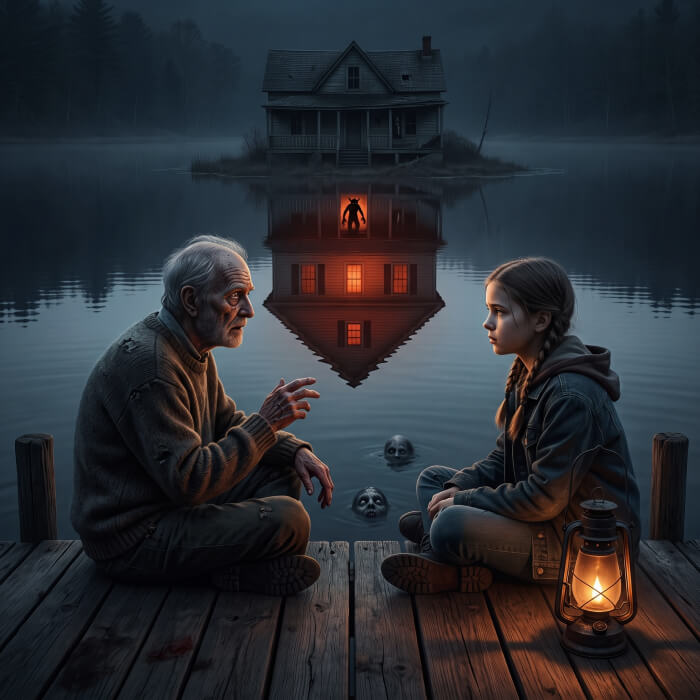
James asked to ride up front, which meant he was having a good day, or wanted me to think he was.
He got in on his own. Buckled his own belt. Sat with his hands folded on his knees like a man on his way to church, and for the first eleven miles he didn't say anything at all, and I let the road do the talking — that stretch of county highway past the grain elevator, past the place where the Sinclair used to be before it burned, past the sign for the fairgrounds that's advertised the same August since I was in high school.
Then he said, "Your mother hated this drive."
"She did."
"Said the trees made her feel watched."
"That was Olivia," I said. "Mom said the trees made her carsick."
He thought about that. His mouth worked, the way it does now, chewing on a word before he lets it out. "Well," he said finally. "One of you."
That's the thing nobody tells you about the disease. It doesn't take everything at once and it doesn't take it in order. It takes the mortar and leaves the bricks. James could still tell you the gear ratio on a '78 Ford and the name of the dog he had at nine, but he'd stopped being able to keep his two daughters separate, and one of us had been dead for twenty-two years.
Stepdaughters. I should say stepdaughters. He never once corrected anybody who assumed otherwise, and I never once corrected him.
In the pocket of the driver's door there was a little black recorder I'd bought online for nineteen dollars. On the floor behind my seat there was a thermos. I'd told the home I was taking him to a doctor's appointment in Fairhaven and I'd told my husband I'd be back Sunday and I'd told nobody at all where we were actually going, because there is a version of this where I come back alone, and I had spent four months making sure that version would be boring to look into.
I want to be honest about that. I didn't drive out there to understand anything. I drove out there because his mind was coming apart, and when a mind comes apart the true things fall out of it first, and I had twenty-two years of waiting to collect on.
The lake sits in a bowl of low hills that nobody farms because the soil is bad and the water table's high, and the road down to it turns to washboard about a half mile out. Six houses on the north shore, all of them shut for the season. Ours is the last one, past the bend, low and brown with a green metal roof my mother picked out of a catalog in 1994.
Nobody had been out here in two years except a kid from town James paid to check the pipes.
The key was under the same rock. Inside, the air had that closed-up taste — mouse and mildew and cold ash. My mother's spoon rest was still on the stove, the ceramic rooster with the chipped comb. There was a jar of instant coffee in the cupboard with a bloom of rust around the lid.
James stood in the doorway of the kitchen with his coat still on and looked at everything like a man being shown a photograph of a place he'd only heard described.
"We stayin' long?"
"Just the one night."
"Good," he said. "It's better in the morning."
I got the woodstove going. I made him a plate of the food I'd packed. Outside, the light went that flat orange it goes in November, and the lake took it and held it and gave nothing back, and I stood at the sink and looked out at the dock and let myself feel it, that old low-frequency hum in the back of my teeth that I only ever get here.
Down at the end of the dock, the boathouse door had a padlock on it.
A new one. Bright, unscratched brass, hanging in a hasp that was orange with rust. Somebody had put a new lock on a building nobody had opened in two years.
I remember thinking: huh.
I remember thinking I'd ask James about it later, and then not asking.
He got sharper after dark. They do sometimes. It's like a fever breaking backwards.
We sat at the table and he ate and I asked him about the summer of '02, and he answered, and I let it be easy at first. What the weather was like. Whether Mom's back was bothering her. Who came out that year and who didn't. He remembered that the folks in the blue house had a pontoon and that Olivia had gotten a job at the Dairy Whip in June and quit it in July.
"She was fifteen," I said.
"She was fifteen," he agreed.
"And I was eleven."
"You were eleven." He looked at his fork. "You were a mean little thing at eleven."
"Was I."
"Not mean," he said. "That's not the word." His hand made a small tired circle in the air, hunting. "You went quiet. When you got mad you didn't yell, you went quiet, and then something'd happen and I'd never be able to prove it was you. Your mother's car window. That cat down at the blue house."
"I don't remember that."
"No," he said. "You wouldn't."
The stove ticked. Outside, wind came off the water and pushed at the house, and somewhere down the shore a loose gutter knocked twice against a soffit, and I thought, with the recorder running in my coat pocket on the back of the chair, here it is, here's the door, walk through it.
"James," I said. "What happened to Olivia."
He set his fork down. He looked at me for a long moment with those flooded old eyes, and I swear to God he looked relieved, and I mistook that. I mistook it for a man tired of carrying something.
"Slack water's at four," he said. "We'll go out and I'll show you."
"Show me what?"
"You know what." He pushed his plate away, two inches, the way he always did. "You always know what. That's the trouble with you, Emma. You always know and you never keep it."
I woke at ten past three because the door was open.
Not banging. Just open, and the cold coming up the hall in a long flat sheet, and the sound of the lake, which is not really a sound, more an absence with edges.
James was on the dock in his undershirt and his socks.
I want to say I ran. I didn't. I stood in the doorway in my coat and my boots with my hands in my sleeves and I watched a seventy-one-year-old man walk to the end of a dock in November in his socks, and I thought — clean as a bell, no static in it at all — if he goes in, that's an accident.
He didn't go in. He stopped at the end and stood over the black water with his arms hanging and he talked to it. I got close enough to hear.
"—can't keep doin' this," he was saying. Conversational. Like a man on the phone with a contractor. "You know I can't. It's gettin' away from me. Last week I called the girl at the desk your name."
The water didn't say anything.
"You gotta let her finish it," James said. "That's all I'm askin'. Let her finish it this time."
"James."
He turned around. He wasn't startled. He looked at me the way you look at weather.
"There you are," he said. "Get the boat."
"It's three in the morning. It's twenty-eight degrees."
"Slack water's at four," he said, patient, like I was the one losing my grip on the calendar. "You can't do it on a tide. You gotta do it on slack water or it comes back up in the reeds down by the blue house."
And there it was.
I got very calm. I have a talent for that, it turns out. It's the family talent.
"What comes back up," I said.
James's face did a thing I'd never seen it do. It came apart in stages, like a building. The jaw first, then the mouth, then all of it, and he put his hand over his eyes.
"Oh, honey," he said. "Not again."
I got him inside. I got him in the chair by the stove with a blanket and I put the recorder on the table between us where he could see it, because I wanted it clean, because I wanted a court to be able to look at it, and I said, "Tell me what happened to Olivia," and James told me.
He said it was the second week of August. He said the two of us had been at each other all summer, that Olivia had a boyfriend in town and I hated him and I'd told Mom about the beer in her closet and Olivia had gotten a whipping for it, and that for three days after, Olivia had done the thing she did, which was to be perfectly sweet in front of the adults and to say one small unsurvivable thing to me every time we were alone.
He said he'd been up at the house with a carburetor in pieces on newspaper on the picnic table.
He said he heard the splashing and thought it was the two of us horsing around, because it sounded like it. Because that's what it sounds like.
He said by the time he got to the dock there was one girl in the water.
"She was holdin' on to the ladder," he said. "The bottom rung. Both hands. And she was so calm, Emma. That's what I — that's the thing. You were so calm. You looked up at me and you said, 'She wouldn't stop.'"
The stove ticked.
"You were eleven," James said. "Eleven years old. And I stood there on that dock and I thought about your mother, and I thought about a courtroom, and I thought about you at eleven in a room with a state psychologist, and I made a decision, and I have never once —" His voice went. He got it back. "I have never once been sure it was the right one. But I made it. I put you in the truck and I burned your clothes in the barrel and I told your mother it was the boat. I told the sheriff it was the boat. I told everybody it was the boat and I let them look at me for eight years like I was something scraped off a shoe, and I let them, because every day they were lookin' at me they weren't lookin' at you."
"That's not what happened," I said.
"It's what happened."
"I remember it. I remember the boat. I remember her going under by the second buoy and I remember Mom on the shore —"
"Your mother was at the Kroger in Fairhaven," James said. "It was in the paper. Everything you remember was in the paper, honey. You read it and you read it and you read it till it went in and covered the other one over. I watched you do it. I let you do it. That's the part I'll answer for."
I sat there.
I want to tell you I felt it come back. I want to tell you there was a door in me that opened and the ladder was on the other side of it, the cold and the two white hands on the bottom rung and my sister's face going in and out of the water like a light with a bad connection.
There wasn't. There's nothing there. There has never been anything there. That's what I've had instead of a memory: a smooth place, a paved-over place, and a whole adult life built on top of it, load-bearing, and a stepfather I have hated with a purity that got me through my twenties.
"Why now," I said. My voice came out level. "Why tell me now."
"Because I'm goin'," James said simply. "I've got maybe a year before I can't hold it. And when I can't hold it, it's gonna come out of me in front of a nurse's aide, or a stranger, or your husband. And then it's out and it's out forever and you'll have to live the rest of it as that." He leaned forward and put his old hand on my knee. "So we're gonna go out at slack water. And you're gonna do what you came here to do. And it'll be one man who did a bad thing at that lake, and that's all it'll ever be, and you go home."
He patted my knee twice.
"You promised me," he said.
At four the wind had quit and the lake was a sheet of black glass and there was frost on the gunwales of the little aluminum boat, and I rowed because the motor would carry.
James sat in the bow with the blanket around his shoulders. He'd put his boots on. He was humming something without a tune.
Halfway out he said, "You're gonna feel worse than you think, after. Give it about a week."
"Okay."
"And don't come back out here for a while."
"Okay."
"And Emma." He turned his head. In the dark he was just a shape and a voice, my mother's second husband, the man who taught me to drive a stick in the church parking lot, the man I had spent twenty-two years wanting to see in a cage. "It wasn't your fault. You were eleven. You were a child, and children are just weather, they don't know what they are yet. Whatever they told you at that school about sin, it don't apply to eleven."
"Okay," I said.
We stopped over the deep part, where the old creek channel runs, sixty-some feet.
He didn't fight. I want that written down. He got his legs over the side himself and looked up at me and said, "Slack water," almost fondly, like a man naming a season he liked, and he was so light. That's the thing I wasn't ready for. He was so much lighter than he should have been.
I rowed back with the sky going gray behind the hills.
I tied up. I stood on the dock a long time and let my hands stop.
Then I went up the lawn toward the house to get my bag and my keys and the thermos I never ended up needing, and I was most of the way to the door when the smell reached me.
Coffee.
Warm windows. A gray twist of woodsmoke standing straight up out of the chimney in the still air.
I came into that kitchen and James was sitting at the table.
He had the ceramic rooster in front of him and two mugs poured and his coat over the back of the chair, and his trousers were black with water to the knee, and he was wringing his socks out into my mother's mixing bowl, and he looked up at me and his face was so gentle and so tired that I understood, all at once and entirely, that he had done this before.
That we both had.
That the padlock on the boathouse was mine — bright brass, unscratched, and in the right-hand pocket of my coat, where it had been the whole drive out, where it had been for two years, was the key.
"There you are," James said. He nudged the second mug an inch toward the empty chair. "You get any sleep?"
I couldn't make a sound.
"It's all right." He went back to his sock, twisting it, patient, the water running down into the bowl in a thin bright line. "It's all right, honey. You always look like that at the start."
He set the sock on the stove rail to dry.
"Sit down and get warm," James said. "Slack water's at four."




Comments
0 approved comments
Be the first to comment
No one has said a word about this story yet. Set the tone.