
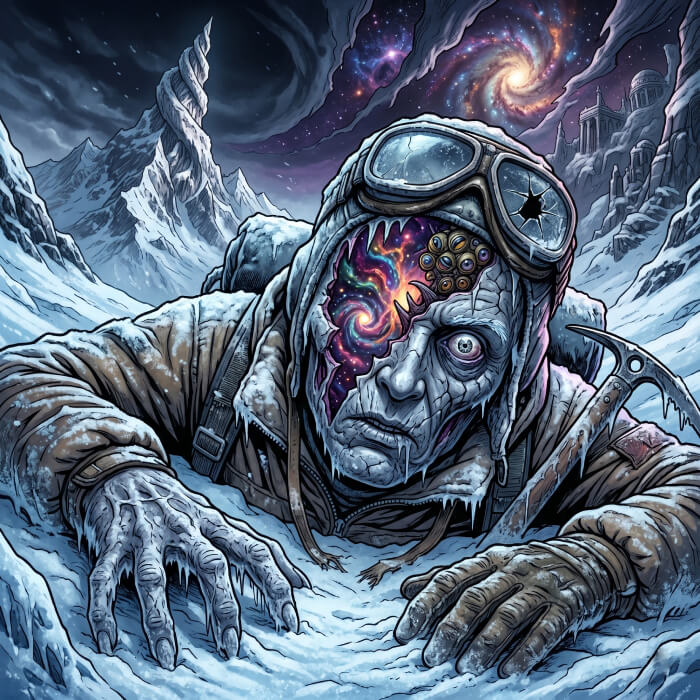
By the time I realized why we were really on Everest, I had maybe ten minutes left to live.
The blood freezing inside my jacket told me that much.
I sat against a wall of blue ice, one glove missing, fingers blackening from frostbite. Somewhere below me, hidden behind clouds and snow, the rest of the team was dead.
Or worse.
The funny thing is, I wasn't scared anymore.
I was angry.
Because I'd finally solved it.
And because everyone else already knew.
The project had been announced as a humanitarian mission.
For decades, Mount Everest had been littered with bodies.
More than three hundred climbers had died there. Some were landmarks now. Frozen into the mountain itself. People gave them nicknames. Used them as navigation points.
Green Boots.
Sleeping Beauty.
Names that made it easier to forget they had once been people.
Then suddenly, governments, sponsors, and wealthy donors poured millions into a recovery initiative.
The largest body-removal operation in history.
The media loved it.
Families loved it.
Everyone loved it.
Except the Sherpas.
None of them would look us in the eye when the project was explained.
A few outright refused.
One old Sherpa named Dorje laughed when he heard the plan.
Actually laughed.
Then he said something in Nepali.
Our translator went pale.
"What did he say?" I asked.
The translator hesitated.
Then quietly replied:
"He said the mountain doesn't keep the dead by accident."
Nobody laughed after that.
I wasn't a climber.
I was a logistics specialist.
The kind of guy who managed equipment inventories and transportation schedules.
The kind of guy who belonged behind a desk.
But the project needed personnel willing to spend months at high altitude.
The pay was absurd.
Enough to wipe out my debts.
Enough to ignore bad feelings.
So I signed.
Everyone signed.
The first few recoveries went smoothly.
Frozen corpses were extracted from ice.
Tagged.
Documented.
Prepared for transport.
It felt respectful.
Necessary, even.
We told ourselves we were doing something good.
Then people started disappearing.
Nothing dramatic.
No screams.
No avalanches.
Someone would simply leave camp and never come back.
A tent would be empty in the morning.
Tracks would lead into a blizzard.
Then stop.
As if the person had vanished mid-step.
The official explanation was altitude sickness.
Confusion.
Poor judgment.
But nobody believed it.
Especially after the radio transmissions began.
The first one came from Team Four.
A routine check-in.
At first everything sounded normal.
Then there was screaming.
Not frightened screaming.
Ecstatic screaming.
Like someone had just witnessed a miracle.
The transmission ended with one sentence.
Over and over.
Repeated dozens of times.
"They're moving."
Then silence.
We never found Team Four.
The sponsors refused to stop.
The government officials refused to stop.
The project leaders refused to stop.
Whenever concerns were raised, new funding appeared.
New personnel arrived.
The operation continued.
It was almost desperate.
As if someone somewhere was terrified of us quitting.
Three weeks later we reached an untouched sector near the northern face.
A graveyard of ice.
Bodies everywhere.
Dozens of them.
Some centuries old.
Some recent.
Frozen expressions trapped forever behind layers of snow.
Our team prepared extraction equipment.
Then Dorje stopped walking.
He stared at the field of corpses.
And whispered:
"Too many."
Nobody understood.
One of the supervisors ordered us forward.
Dorje refused.
The supervisor threatened to fire him.
Dorje looked at him for a long moment.
Then said:
"You think they're dead."
The wind stopped.
Completely.
No sound.
No movement.
Everest became silent.
The kind of silence that feels wrong.
The kind that makes your instincts start screaming.
Then the mountain moved.
Not shook.
Not trembled.
Moved.
Imagine standing beside an elephant your entire life.
Then one day realizing it wasn't an elephant.
It was a flea.
And the creature it stood upon had been sleeping beneath you all along.
That was the feeling.
The horizon shifted.
Clouds parted.
And something emerged.
Not from the mountain.
Inside it.
The summit wasn't a summit.
It was a shoulder.
A shoulder covered in ice.
Covered in centuries.
Covered in human remains.
The thing was so large that my brain rejected it.
Distances became meaningless.
Scale became meaningless.
Its shape stretched beyond sight.
Something ancient enough to wear mountain ranges like skin.
And all across its frozen surface...
Bodies.
Thousands.
Maybe millions.
Embedded within it.
Like insects trapped in amber.
Offerings.
People broke instantly.
One woman tore off her oxygen mask and walked directly toward a cliff.
Smiling.
Another started laughing until blood poured from her eyes.
Several simply knelt.
As if praying.
Dorje screamed at us to run.
Then something looked back.
I don't know if it had eyes.
I only know it noticed us.
And noticing felt worse than death.
The slaughter that followed barely exists in my memory.
Snowmobiles crashing.
Gunshots.
People attacking one another.
A helicopter falling from the sky.
The mountain turning red.
I ran.
Everyone ran.
Somewhere during the chaos, a metal support rod punched through my side.
I kept moving anyway.
Fear can do that.
Hours later I found shelter in an ice cave.
Alone.
Bleeding.
Dying.
And finally able to think.
That's when the pieces came together.
The funding.
The secrecy.
The missing climbers.
The Sherpas' fear.
The desperate insistence on continuing.
None of this had ever been a recovery mission.
The bodies weren't abandoned.
They weren't forgotten.
They weren't victims.
They were payments.
For centuries, people vanished on Everest.
And humanity accepted it.
The mountain took a few lives each year.
A tragic but acceptable cost.
Then modern technology arrived.
Recovery operations improved.
Safety improved.
The number of deaths started falling.
The offering was shrinking.
The balance was changing.
Someone noticed.
Someone important.
Important enough to understand what slept beneath the mountain.
And important enough to know the consequences of starving it.
So they adapted.
If natural sacrifices decreased...
Artificial ones would be needed.
That's why they hired us.
That's why they paid so much.
That's why concerns were ignored.
That's why nobody stopped the project.
We weren't there to remove bodies.
We were there to replace them.
Hundreds of fresh offerings delivered directly to the altar.
A maintenance operation disguised as a rescue mission.
I started laughing.
The sound echoed through the ice.
Dad would've laughed too.
Whenever I got cornered by bullies as a kid, he'd always say:
"If you can't beat them, join them."
I used to think it was terrible advice.
Now I understood.
Someone, long ago, had discovered the thing beneath Everest.
And instead of fighting it...
They joined it.
Fed it.
Worked with it.
Built traditions around it.
Built lies around it.
Built an entire system around keeping it asleep.
A shadow passed over the cave entrance.
The temperature dropped instantly.
I looked outside.
The clouds had cleared.
Far above me, impossibly distant, something was moving beneath the mountain's skin.
Slowly.
As if waking.
As if hungry.
As if wondering where its next meal would come from.
My blood pooled across the ice.
Warm for only a few seconds before freezing solid.
I knew then that nobody would find me.
And even if they did, they wouldn't bring me home.
They couldn't.
The dead had to stay.
The offering had to remain.
Otherwise something much larger might decide to stand up.
And if it ever stood up...
There wouldn't be a mountain left.
Only the thing beneath it.
Waiting.
Hungry.
And finally awake.

Comments
0 approved comments
Be the first to comment
No one has said a word about this story yet. Set the tone.