

They told Evelyn, when she rented the last motel room on the edge of town, that some things were better left unlooked at. The clerk at the diner wiped her hands on her apron and said it like she was warning a child: "Do not follow it. Not if it moves like it does."
Evelyn smiled the way a woman who had built a modest career poking holes in local myths always smiled: polite, slightly superior. She had a recorder in her bag, a camera, and a notebook full of neat questions. She wrote stories about small places for a living, collecting other people's uneasiness and arranging it into tidy episodes that paid the rent. This place was a string of three houses and a rusted rail siding where the tracks leaned toward the swamp like tired teeth. The town had a name whoever owned the diner had no interest in repeating. Locals called the place "Blackbend" when they were alone and used a lighter voice when the tourists came.
Lucas drove the two of them out that afternoon in a truck that complained every hill. He was less interested in the folklore and more in the lighting. He had insisted on coming; he wanted the cinematics for his small documentary channel. He liked low light, and the way the light softened Evelyn's cheekbones. He set up his tripod with a careful, ungentle patience. He was the kind who loved to hold an image until it confessed.
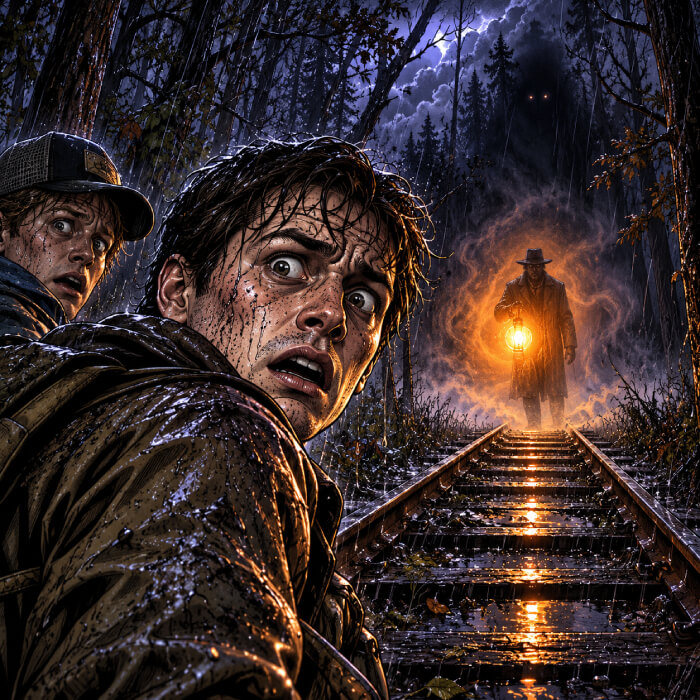
At dusk they walked the tracks. The rails gave a cold metallic song underfoot. The trees on either side crowded close so the world narrowed to the path and the sky. Far down, past the bend where the rails slipped into a tangle of weeds and one forgotten signal post, something glowed.
It did not glow like a fire or like the yellow of a distant headlights. It was small and hard-edged, like a jewel caught in a mesh of dark. Up close the color shifted — at times a deep, wet blue; at times a green that made the skin of things look sickly. It bobbed, not in the way a lantern would, but with a jerky, searching motion as if someone tried to steady a light on a string and the hand could not stop shaking.
There were stories for every taste. The waitress had told Evelyn about a man who worked nights, a brakeman who once misjudged the switch and was split from shoulder to shoulder. An old man at the gas pump had a different version: a foreman who had been beaten to death with a spike in a jealous quarrel. A boy at the hardware store said it was a prank, a group of kids with glow sticks and fishing wire. Evelyn wrote them all down like ingredients, neutral as any scientist.
They staked out the bend that night. Lucas ran cameras while Evelyn listened. Her recorder picked up the rust of the forest, the distant freight horn like a whale's call, and the occasional crunch of something alive in the underbrush. The light came at midnight, floating low and keeping to the curve as if the tracks were a groove it could not leave. It paid them no attention until Evelyn stood, half-mocking, stepped off the ballast, and followed.
She told herself she was following for the job. She told herself she was following because it was her job to watch phenomena, to map where the facts broke and the stories began. The light drifted through the trees with that soft, erratic bob. It stopped and hovered in a clearing, then moved again, beckoning with a patience that felt like hunger.
Evelyn should have turned back. Lucas called to her from the tracks and his voice got small. She had been told to keep the cameras rolling; this was the footage he wanted to capture. Besides, the light was beautiful in an ancient, private way. It made the leaves silver. It made the dark feel thin, like a painted curtain barely tacked to a frame.
When she reached it the world did a strange, small tilt. The light did not belong to anything she could see. No lamp, no lantern, no hand. It hung a breath away from the ground and pulsed once — not a flash, but a single, deliberate throb — and for a second Evelyn felt certain the thing was looking at her.
A voice said her name.
It was not Lucas. It was not anyone she knew. It was a child's voice, high and tentative, and it said Evelyn like a question. The sound folded around her ribs. Her mouth answered before her mind could ask the question: "Who are you looking for?"
The light bobbed. The child's voice made the name low, then high, as if testing syllables. It sounded like the voice you hear on a scratched record, half a memory and half a trick of the machine. Then the light moved again, away and deeper into the low growth.
She followed.
She found tracks. Not the train tracks, but the shallow foot-trails of something that had threaded the swamp for years. She found, nailed to a post, a small brass plate that had once held a name. The letters were chewed away by time. She found a child's mitten rotted to the size of a coin. She found fresh prints that matched nothing she knew. Each discovery made her feel less like an investigator and more like a person being gathered.
Between the trees, on the far side of the clearing, there was a low sag of earth where the ground had been disturbed and then left. A rusted lantern sat half buried in moss, its glass long gone. When Evelyn put her hand on the metal a rush of images came through her like a spill. She saw a man in a cap running with a lamp and a whistle. She saw a face turned up, laughing at the summer air. She saw the same face flattened and bright in a wash of iron and smoke. She saw people standing with folded hands and eyes that would not move on. She saw, impossibly, herself sitting at the kitchen table as a little girl, a plastic locomotive on the linoleum. She heard a child's laughter that was not for her.
She jerked her hand back and the images were gone. The lantern was cool and empty. Her heart hammered and when she laughed it sounded like a sob.
They left it at that for the night. Lucas was pale and wished loudly for the honest pole of his camera batteries to have their way in the world. He said they had enough footage. Evelyn agreed, but she could not sleep. The town's motel room was thin-walled and smelled faintly of cigarette smoke. She listened to the hum of the refrigerator and the sound of the road and thought of the light as if it were a person who might be sitting on the bed in the dark.
That morning she found, pushed under the windshield wiper of Lucas's truck, a note in a child's hand. The handwriting trembled like a leaf. It read: You left your hat.
Evelyn had not left any hat. Lucas had joked that someone around Blackbend liked to leave gifts. She took a photo and handed the note to him, because photographing evidence was a familiar defense. Lucas pocketed the paper with his camera accessories and pretended not to look at her too long.
Over the next week she kept watching. Each night the light would come and each morning there was something new, small and impossible, placed not far from the motel doorstep. A coil of hair tied with a blue thread. A tiny, perfect shoe with one laces burned away. A photograph folded at one corner showing a man with coal-dusted hands and a missing tooth. The photograph had been taken long before Evelyn was born, but on the back in pencil was a single word she did not recognize until she read it aloud in the bed: Evelyn.
At the diner a woman with walnut hands said, quietly, "It remembers names. It learns them. My sister used to whistle to it in winter and the light would come close. Then she was always gone. Folks started writing names on things and leaving them, like calling it by the right voice."
Evelyn did not want to believe that any of her story could be altered by other people's attention. She had written about haunted houses and roadside crosses and men who never stopped believing. She knew, intellectually, that attention could create the thing it worried about. But there was a terror in being the one to attach a name to a place that already wanted one.
She started to dream, and with each dream the light painted itself with new tenderness. In the first she was five years old and hiding behind a table while a grown argument bled at the edges of the room. In the second she was in a classroom and the teacher slid a note across the desk and someone said the wrong name. In the third she was older and every photograph she had taken of her mother had a small, bright dot of color in the corner.
In the waking hours she felt a pull like gravity. She found herself writing a small piece for her column on a whim: a short thing, an experiment in tone, a place piece about Blackbend and its light. She wrote it to capture the curiosity, not the horror. She left out the recordings that made her skin prickle. She left out the part where the light called her name.
The piece went up on the website with an ordinary headline. It was not meant to be exclusive; it was meant to be readable, to be clicked. She slept better that night. Lucas said, "There. Now it's done. We can go."
They left.
They did not see anything at first. The town carried on like a town carrying on. People washed the dishes and picked up their mail and tended to businesses that had more practical sorrows than an unexplained glow. Then one by one their phones pinged. The piece had been shared. Someone in a larger city had a taste for oddities and had passed it on. The views climbed. The piece lived where stories do now: in feeds, in late-night threads, in the mindless orbit of strangers clicking.
On the third day after they left, a woman in a suburb sixty miles away sent Evelyn a photograph of a light over her backyard and asked, in a text, "Is this the same?" The photo was fuzzy and small and the light in it bobbed like a fish. In the comments under the online post strangers wrote names. They wrote names with confidence and with mockery, and they rephrased the variations of the story until the legend had lined itself in new clothes.
A month later Lucas called. He was laughing in a way that first sounded joyful, then thin. "You are not going to believe this," he said. "They put up a blog about it in a foreign language and there are people saying they've seen… there's even video."
Evelyn felt an ache in her throat that had nothing to do with pride. She watched the feeds, each new sighting a little pinprick. The light did not stay local. It drifted into phone cameras and into highways and into the glare of stadium lights. It learned fast. Where people pinned names to it, it hung the names like ornaments. Those who watched saw their own faces reflected in it, flattered and bright and suddenly open to suggestion. A man in another town filmed it and the audio, when slowed, had a child's voice saying his name. A family left a birthday candle by their porch and woke to find an extra seat at the table with no one in it.
It took Evelyn a little time to see the pattern, then everything snapped into a kind of crystalline horror. The more people told the story, the more the light had places to live. They had given it identity. They had given it appetite.
She tried to scrub her piece from the web. She asked for removals and reached out to the places that had republished it and found the request met with protocols and apologies and then nothing at all. The story had been copied and archived and it sat like a seed in a thousand soils.
She began to forget small things. At first it was nothing important: the name of a girl who had once cut her hair into a blunt fringe and cried because it did not suit her. Later entire images went blank, as if someone had cropped them out of a frame. She would lift her hand to a shelf and not remember why the shelf was there. When she tried to recall details of her childhood she found them replaced with other things: a whistle, a lantern, a whistle again. She catalogued it, because cataloguing was the human thing to do, and because lists made people feel safe. She wrote the names down on index cards and pinned them to the wall like a shrine.
On an evening when rain scraped the windows and the sky had the look of someone who had forgotten a promise, a package arrived for her. It had no return address. Inside was a Polaroid. A woman sat on the porch of a little house, smiling. She held a candle. Behind her, on the dark curve of the road, a small light hovered.
On the back was a single word in a child's shaky hand.
Evelyn.
There are rumors about what happens to someone whose name the light learns; they are part of the new geography of the thing. People say you are taken apart like a song: removed note by note until someone else can hum the tune. Others say you are signed into a ledger under the rail ties and the ledger grows heavy with names.
Evelyn did not know which rumor to expect. The night the light came for her properly it did not arrive with a ghostly trumpet or an apocalyptic howl. It came the way a rumor arrives: quiet, intimate. It stood at the edge of her bed like a person who had been invited and was waiting for the host to notice.
It said her name and for the first time she could not tell if it was the voice that belonged to the light or the light that belonged to the voice. It spoke in the voices of all the strangers who had written the story and the voice of the child who had thrust her name on a scrap of paper under a windshield wiper and the voice of the waitress who had warned her. It was everyone's voice that could be used to call.
Evelyn answered. She had rehearsed answers for a dozen skeptical editors and a hundred listeners. None of them held. She wanted to say she was a reporter. She wanted to say she had never meant harm. The words dried in her mouth like bread crust.
The light touched the inside of her eyelids and elevator doors in her memory opened. She was walking the rails as a child, or maybe it was not a memory at all but a borrowed scene: a lamp passed hand to hand under a sheet of rain, faces set like old coins. She saw a hundred small gestures — names tucked into pockets, names carved into wet wood, names scrawled on the edges of maps — and with each she felt something inside her shift.
She did not die. At least not in the terrible sense the townsfolk had once imagined. She became a record. Her voice on the tapes turned thin and high; when people played her old interviews they said she sounded like a child. Her photographs developed a faint, consistent distortion: a small glowing orb off to the side in the corner, always there and always watching. When friends tried to call her they reached an answering message that repeated, in a gentle monotone, a list of names someone had given it.
The twist came later, for those who read her work and did not know her. The light expanded outward like an infection of attention. The thing that began by being tethered to a small bend in the tracks had, through her words, become portable. It learned new tongues. It learned to arrive for strangers in the middle of the night and look like a lost phone or a child's sparkler. People who saw it sent it photos, and those photos found their way back to the feed and became part of the light's diet. The world that had once been careful because it did not know what to do with grief learned to feed a new hunger.
The ledger, wherever it was, filled.
At the end there was a simple note pinned to the old signal post at Blackbend, nailed there by a hand that trembled and was not unknown. The note had been pinned by someone who had watched the light and decided that a single act might still matter. It read: If you see it, do not follow. If you hear it say your name, do not answer.
Underneath, someone had written an addendum. It was not in the careful hand of a clerk or a tourist. It was the small, spidery script of a child who had learned to keep secrets. The addendum read: It likes names. It likes being known.
Evelyn's piece was still online. People still clicked it. They still typed names into the comment threads and laughed at the old superstitions and shared the clip like a joke. Some of them said it was phishing for attention, some said it was a performance art piece, and a few posted messages from the dark hours: "I saw it tonight. It had a face like my sister. It called her name."
The last thing Evelyn ever did that any stranger could find was a short, impersonal email to an archivist asking to have her old files preserved. Her subject line was a practical thing: Notes from Blackbend. The archivist opened the files because he was paid to open files. He later wrote that the tapes had a problem; the audio track was full of static and, through the static, a child's voice counting off names in quick succession. On the final tape, the voice paused, and then, clear and soft, it said Evelyn.
In time the light became a rumor that moved beyond one curve of track. It crossed highways and the margins of ballrooms and the faces of security cameras. People put names on paper and left them on doorsteps and woke with a new absence at the place in their life where something important should be.
And sometimes, on quiet nights when the road runs like a thin ribbon of silver and you think you are alone, a small light will appear far off, bobbing like a jewel on a string. If you watch it long enough your own name might come to you, spoken in a voice you know from childhood and from the stranger next door. If you say your name back, it will answer with a smile that is not yours, and if you write your name down and put it near where the tracks used to be, perhaps the light will learn it and wear it, like a charm.
People still complain, sometimes, that the story is unfair. They say that legends are photographs of the past and should be handled with gloves. The world is full of people who will continue to look, and who will continue to think that looking is harmless.
If you see a light on a bend in the rails and it bobs like someone holding it and forgetting to be strong, do not follow, is what the note said. Look, of course you will look. All the rest was left for those who had already been looking. The light keeps a very tidy ledger. It likes names.
Someone, somewhere, still clicks on Evelyn's old post and scrolls the comments. Beneath the usual mockery and disbelief there is a new line, added by a hand that trembles with the confidence of those who have just learned a new thing. The line reads simply: I saw it. It smiled my face back at me.
A small, bright orb sits in the photograph attached to the comment, hovering near the corner like a punctuation. If you squint, on the Polaroid, the light leans into the shape of a smile.






Comments
1 approved comment
Join the discussion
Share what stayed with you after reading.
Chinmoy Sarker
5 months ago
Oh my GOD!