

James had been told the trail was unmarked for a reason. The old growth forest didn't welcome hikers, didn't yield its secrets to anyone with a walking stick and a water bottle. But he'd needed to get away from the cabin, away from the silence that pressed against his eardrums like water pressure, away from the divorce papers he'd left unsigned on the kitchen table.
The smell hit him three hundred yards past where the path disappeared.
Not rot. Not yet. Something else. Something wrong.
It was sweet. Cloying. Like someone had baked a cake in a sealed room and let it ferment. Like flowers left too long in stagnant water. The kind of sweetness that made his teeth ache and his stomach twist with something older than nausea.
James should have turned around.
He didn't.
The undergrowth was thick here, mountain laurel and rhododendron grown wild, their branches interlocking like fingers. He pushed through, thorns catching his jacket, and found the clearing.
The man sat against an oak tree, legs splayed, head tilted back at an angle that suggested he'd been looking up at something when he died. His hands rested in his lap, palms up, fingers curled slightly. Waiting hands, James thought, then hated himself for thinking it.
He'd been there for days. Maybe a week. The August heat had done its work, and the August insects had done theirs. But the smell... the smell wasn't decomposition. Not entirely. It was something the body was making, some alchemy of flesh and fermentation and the particular damp of this hollow.
James vomited into the ferns.
He called 911 with shaking hands. The dispatcher's voice was professionally calm, asking him to confirm what he'd found, asking him to stay on the line, asking him to remain with the body until officers arrived.
"How long?" James asked.
"Nearest unit is forty minutes out. Stay put, sir. Do not touch anything. Do not disturb the scene."
Forty minutes became an hour. The sun, already low when he'd found the clearing, sank behind the ridge. The forest changed. Day birds stopped. Night birds started. Something moved through the undergrowth to his left, heavy and unhurried. James sat ten feet from the dead man, close enough to see the silver glint of a wristwatch, far enough to pretend he couldn't see the rest.
He turned on his phone's flashlight. The beam caught the man's face and James wished it hadn't. The eyes were gone, of course, but the sockets seemed too dark, too deep, like holes dug into something that continued downward. The mouth hung open. James could see the tongue, black and swollen, and something else behind it. Movement. Maggots, probably. Or his imagination.
"Sorry," James whispered. "I'm so sorry."
The dead man didn't answer.
The police came with lights and radios and the efficient choreography of professionals who had done this before. They asked James questions. He answered in monosyllables. They offered to drive him back to his cabin; he said he'd walk. The trail was marked now, temporarily, with yellow crime scene tape that would be gone by morning.
He didn't sleep that night. He lay in the dark and smelled sweetness that wasn't there, convinced it had followed him home, clung to his clothes, sunk into his pores. At 3 AM, he showered for the third time, scrubbing until his skin burned.
He found the first note three days later.
It was tucked under his windshield wiper, written on paper that looked old, that smelled old, like the pages of a book left in a damp basement. The handwriting was cramped, urgent, written with something that had bled slightly into the fibers.
You shouldn't have looked.
James called the sheriff's department. They checked the cabin's perimeter, found nothing. No footprints, no disturbed earth, no evidence that anyone had been near his car. The deputy suggested kids playing a prank, locals who'd heard about the body, the kind of people who thought death was entertainment.
"Guy was a suicide," the deputy said. "Name was Henry. Lived alone in a house about two miles from where you found him. No family, no friends anyone knew about. Left a note, actually. Want to hear it?"
James didn't, but the deputy read it anyway.
"The ground here is tired. It wants something sweet. I have been sweet enough for long enough."
The dreams started that night.
James stood in the clearing, but it was wrong. The trees grew inward, branches meeting overhead to form a ceiling. The dead man sat in the same position, against the same oak, but he was fresh now, newly dead, his skin still holding color, his eyes still in their sockets. They were open. They were looking at James.
"You smelled me," the man said. His voice was wet, like speaking through honey. "You came looking. You disturbed."
"I called for help," James said. In dreams, you always explain yourself. You always think reason matters. "I stayed with you. I didn't leave you alone in the dark."
"Left me?" The dead man laughed, and the sound was the maggots moving, was the gas escaping swollen tissue, was the particular music of decay. "I was resting. I was becoming. The ground was taking me back, slow and sweet, and you pulled back the curtain like a child at a birthday party. Surprise. You wanted to see. You wanted to know."
"I didn't--"
"You smelled me. You followed your nose like a dog. You couldn't let me be." The dead man stood. In the dream, this was the worst part, the impossible part, because his legs moved together, stiff and wrong, and his head stayed at that impossible angle, still looking up, still looking through James at something above. "Now you smell like me. Now the ground is interested in you."
James woke with the taste of sweetness in his mouth, so thick he gagged. He ran to the bathroom and spat into the sink, expecting bile, expecting blood. What came out was clear and viscous, like nectar, like the dew on flowers left too long in the sun.
He didn't call the police. What would he say? The dead man is visiting me. The dead man is making me produce honey. They'd commit him. They'd be right to.
The second note arrived a week later. This time it was inside his cabin, on the kitchen table, placed carefully on top of the unsigned divorce papers.
She left because she could smell it on you. The sweetness. The rot beneath. You were becoming even before you found me. I just hurried things along.
James burned it. He burned it and opened every window and still smelled it, that terrible sweetness, coming from inside his own throat.
He tried to leave.
Packed his car at midnight, planning to drive until he hit an ocean, any ocean, anywhere without trees that grew too close together and ground that wanted to digest him. The car started. The headlights cut through the dark. He made it to the end of the driveway before he saw the figure standing in the road.
Not Henry. Not yet.
It was a woman, or had been. She wore a dress that might have been white once, now green with age and something else, something that dripped. Her head hung forward, hair obscuring her face, but James could see her hands. They were raised, palms up, fingers curled slightly. Waiting hands.
He slammed the brakes. She was gone. The road was empty. But when he rolled down his window to be sure, to be certain, the smell rushed in, that overpowering sweetness, and beneath it something else, something that understood patience, that understood hunger.
James reversed back to the cabin. He knew, then. He understood what Henry had been doing in those woods. Not hiding. Not dying. Transforming. Becoming something the ground wanted, something that could wait and whisper and collect.
The dreams worsened.
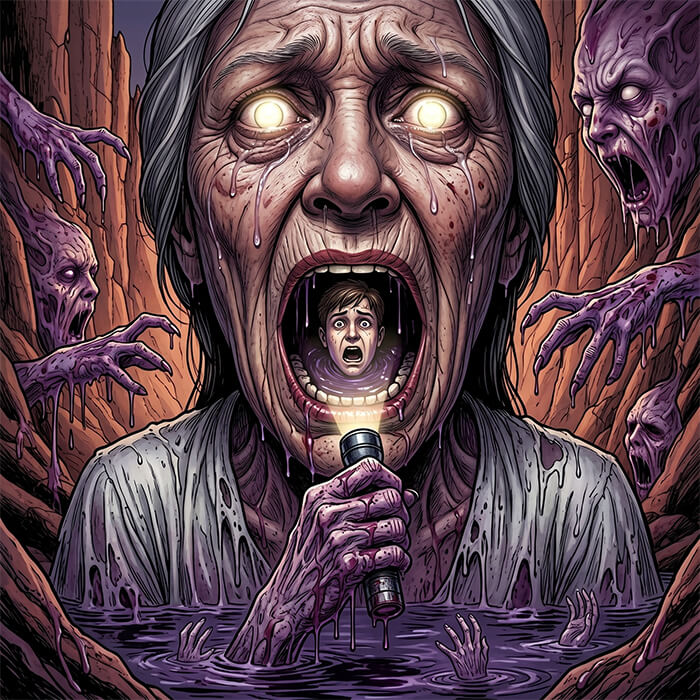
Henry brought others. The woman from the road, and a child with no eyes, and an old man whose skin moved with things that weren't veins. They sat in a circle in the clearing that was a room that was James's bedroom, and they spoke of sweetness, of the generosity of flesh, of how James had been so kind to volunteer.
"I didn't volunteer," James told them. "I found you by accident."
Henry smiled. His teeth were black, and between them, moving slowly, were the maggots that had been behind his tongue. "There are no accidents in hungry ground. You were walking there because you were already walking here. The smell found you because you were already smelling yourself."
"That's not-- I'm not--"
"You left her because you knew what was growing in you. The anger. The sweetness of it. The way it ferments if you hold it long enough." Henry leaned close, and his breath was the clearing in August, was the car in the dark, was every enclosed space James had ever feared. "Kill yourself, James. Do it now, while you still taste like you. Before the ground takes you piece by piece and you feel every bite."
James woke screaming. But the scream tasted like honey, and when he wiped his mouth, his hand came away sticky and golden and alive with the scent of flowers he couldn't name.
He found the third note in his own handwriting.
He didn't remember writing it. He would have sworn, would have passed any test, that he'd never seen the paper before, never held the pen that had pressed these words into existence. But it was his hand. His loops and slants. The way he crossed his t's with a small pause, a hesitation, like the pen had needed to think.
The ground here is tired. It wants something sweet. I have been sweet enough for long enough.
Below it, in a different hand, in Henry's cramped urgency:
Yes. Finally. Yes.
James understood, then. The notes weren't threats. They were invitations. Henry hadn't been angry that James found him. Henry had been grateful. The suicide in the woods, the waiting in the dark, the dreams and the sweetness and the slow transformation of James's body into something that smelled like flowers and rot... it was a process. A recruitment. Henry had been alone in that clearing, alone in his becoming, and James had offered himself. Had followed his nose into the undergrowth and volunteered to keep him company.
Forever.
He went to the kitchen. The knives were clean, sharp. He could end it properly, quickly, before the ground took him the slow way. Before he became like Henry, like the woman in the road, like the child with no eyes. He could cheat the forest of its meal.
The knife was in his hand. The blade pressed against his wrist, and he felt the sweet pulse of his own blood, heard it singing to him of endings and peace and rest.
Do it, whispered Henry from somewhere behind his eyes. Become with me. The ground is wide. The ground is patient. The ground has room for two.
James pressed harder. A bead of blood welled up, and it wasn't red. It was amber. It was golden. It smelled like the clearing, like the cabin, like his own mouth in the morning.
He dropped the knife.
"No," he said aloud, and the word tasted like honey, like surrender, like the first bite of something that would consume him entirely. "No, I won't give you that. I won't make it easy."
Henry laughed, and this time the sound came from James's own throat, wet and eager and young, like something just beginning to grow.
That was six months ago.
I write this now from the clearing. I don't remember walking here, but here I am, sitting against the oak tree, legs splayed, head tilted back to look at something I can't quite see. My hands rest in my lap, palms up, fingers curled. Waiting hands.
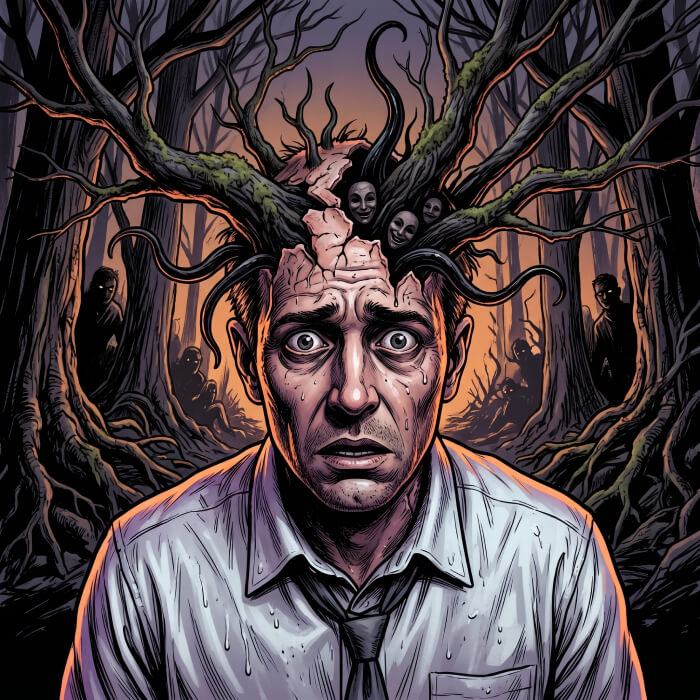
The sweetness is overwhelming. It pours from my pores, from my mouth, from the places where my eyes used to be. I understand now what Henry meant about becoming. The ground doesn't want corpses. The ground wants gardeners. We sit here, we sweet ones, and we send out our scent, our irresistible perfume of decay and transformation, and we wait for someone curious to follow their nose.
Someone like you.
You're reading this because you found my cabin. Because you saw the notes I left behind, the ones in my handwriting that I don't remember writing, the invitations disguised as warnings. You're reading this because you want to know what happened to James, because you followed the trail I marked, because you smelled something sweet and couldn't stop yourself from pulling back the undergrowth.
I'm right behind you.
Don't turn around. It won't help. I'm not what I was, and you're already what you're becoming. You smelled me. You came looking. You disturbed.
The ground here is tired. It wants something sweet.
You have been sweet enough for long enough.






Comments
0 approved comments
Be the first to comment
No one has said a word about this story yet. Set the tone.