
Oliver Bennett had never been the kind of man who did things alone.
Not really.
He liked noise—friends talking over each other, music humming from somewhere, the reassuring buzz of people living their lives nearby. Even when he worked from home as an insurance claims analyst, he kept the television running in the background just to fill the silence. So when he told his sister that he was planning a solo hiking trip in the mountains, she laughed and asked if he’d finally lost a bet.
“Just trying something new,” he told her.
The truth was simpler and harder to admit: he needed quiet. His life had become a loop of routine and low-grade anxiety, the kind that sat on your chest at night and whispered that time was slipping away. He had turned thirty-two the previous month, alone in his apartment with a microwaved lasagna and a single candle stuck into the plastic container. Something about that moment had unsettled him deeply.
So he booked a day hike in a national forest three hours from home. Nothing extreme. A well-marked trail. Eight miles in, eight miles out. The kind of thing beginners did to prove to themselves they were capable.
The morning of the hike was perfect.
Cool air drifted through the tall pines, carrying the smell of damp earth and leaves. Sunlight filtered through the canopy in long golden beams that made everything look cinematic. Oliver parked his car in a gravel lot, shouldered his new backpack—still stiff from the store—and stepped onto the trail with cautious excitement.
For the first few hours, everything went exactly as planned.
He passed a few other hikers: an older couple walking hand in hand, a group of teenagers laughing too loudly, a man jogging uphill as if gravity didn’t apply to him. Each encounter reassured Oliver that he wasn’t truly alone. Civilization was never far away.
He checked his watch around noon and smiled.
Four hours in. Right on schedule.
He sat on a fallen log, ate a turkey sandwich, and drank from his water bottle while watching a squirrel dart between branches. The forest felt alive but peaceful, like a cathedral built from trees. He even took a few photos to send to his sister later, proof that he had survived the wilderness.
Then he stood up, stretched, and began the return hike.
At first, he didn’t notice anything wrong.
The trail looked slightly different, but that was normal. Paths always felt unfamiliar in reverse. Shadows stretched longer as the sun dipped toward the horizon, and the temperature dropped just enough to make him zip his jacket.
He walked faster.
An hour passed.
Then another.
The unease began as a small, nagging thought:
This should look more familiar.
He stopped and turned slowly in a circle.
The trees were taller than he remembered. The underbrush thicker. The path narrower.
He checked his phone.
No signal.
A cold knot formed in his stomach.
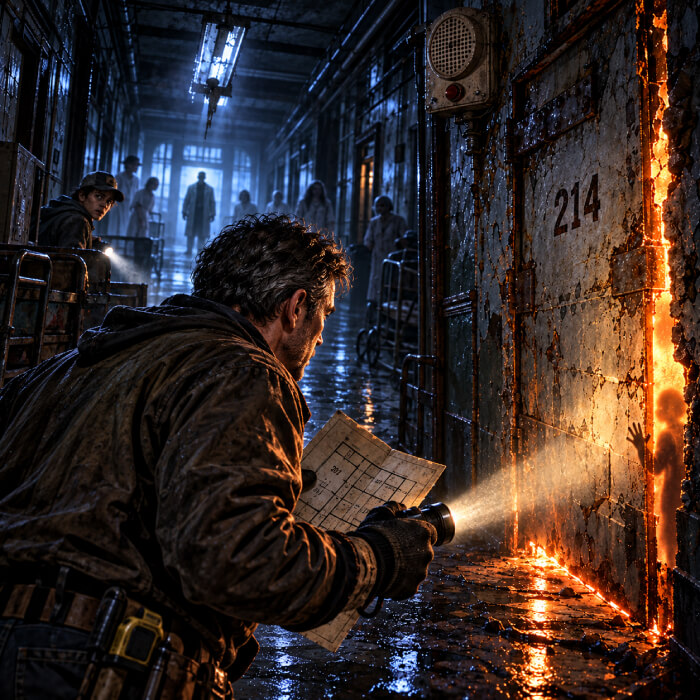
He pulled out the folded map he’d grabbed from the visitor center that morning. His eyes scanned the lines and symbols, but the terrain around him didn’t match anything he could recognize. Panic flickered at the edges of his thoughts.
“Okay,” he muttered to himself. “Stay calm.”
He kept walking.
The sky darkened faster than he expected. In the mountains, dusk arrived like a curtain dropping. Shadows swallowed the forest, and the cheerful chirping of birds gave way to the eerie chorus of insects and distant animal calls.
By the time he realized he was truly lost, night had already taken hold.
Oliver switched on his flashlight.
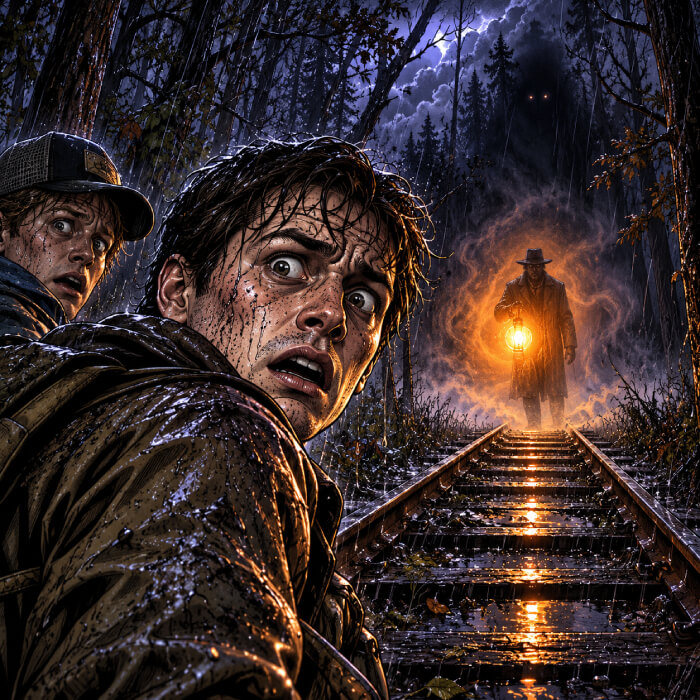
The beam cut through the darkness in a narrow cone, illuminating patches of dirt and tangled roots. Every sound seemed louder now—the snap of twigs, the rustle of leaves, the wind sighing through branches.
He tried to retrace his steps, but the trail had vanished completely.
His heart pounded.
He imagined spending the night exposed to the cold, wandering in circles until exhaustion took him down. He had read enough survival stories to know how quickly things could go wrong.
Then, just as his fear began to crest into desperation, he saw it.
A structure.
Faint and crooked, half-hidden behind a cluster of trees.
Relief surged through him.
He hurried toward it, stumbling over rocks and roots, until the shape became clear: an old cabin. The roof sagged in the middle, and the wooden boards were weathered gray with age. One shutter hung loose, creaking softly in the wind.
It looked abandoned.
But it was shelter.
Oliver approached the door and knocked.
The sound echoed hollowly inside.
He waited.
Nothing.
He knocked again, louder this time.
Still nothing.
He swallowed hard, then wrapped his fingers around the cold metal handle and pushed.
The door swung open with a long, groaning squeal.
Inside, the cabin was surprisingly clean.
Dust coated the floor and walls, but the room itself was intact. In the center stood a single bed—neatly made with white sheets and a thick blanket. A small wooden table sat beside it, holding an unlit candle and a rusted lantern.
The air smelled stale but not rotten.
It felt… prepared.
Oliver stepped inside, closing the door behind him.
“Hello?” he called.
Silence answered.
His flashlight beam swept across the walls—and stopped.
Paintings.
Dozens of them.
Portraits lined every surface, hung in tight rows from floor to ceiling. Each one depicted a person staring straight ahead, as if posing for a photograph. Men, women, children. Young and old.
And every single one wore the same expression.
A wide, unnatural smile.
Oliver felt his skin prickle.
The faces were detailed—too detailed. Their eyes seemed to follow him as he moved, glinting in the flashlight’s glow. Some of the subjects looked cheerful. Others looked terrified beneath their forced grins.
He tried to laugh it off.
“Just art,” he whispered.
But the laughter died in his throat.
He was exhausted.
His legs ached from hours of walking, and his eyelids felt heavy. The bed looked warm and inviting, a sanctuary from the cold darkness outside.
If the cabin’s owner returned, he could explain.
Surely they would understand.
He set his backpack down, kicked off his boots, and climbed under the blanket. The mattress was surprisingly comfortable, as if it had been waiting for him.
He turned off the flashlight.
Darkness swallowed the room.
For a long time, he lay awake, staring into the blackness, aware of the silent presence of those painted faces surrounding him.
Watching.
Waiting.
Eventually, fatigue dragged him into sleep.
Morning arrived quietly.
A thin beam of sunlight slipped through the wall and landed across Oliver’s face. He blinked and stretched, momentarily disoriented. The events of the previous night felt like a strange dream.
Then he sat up.
And froze.
The walls were bare.
No paintings.
Not a single one.
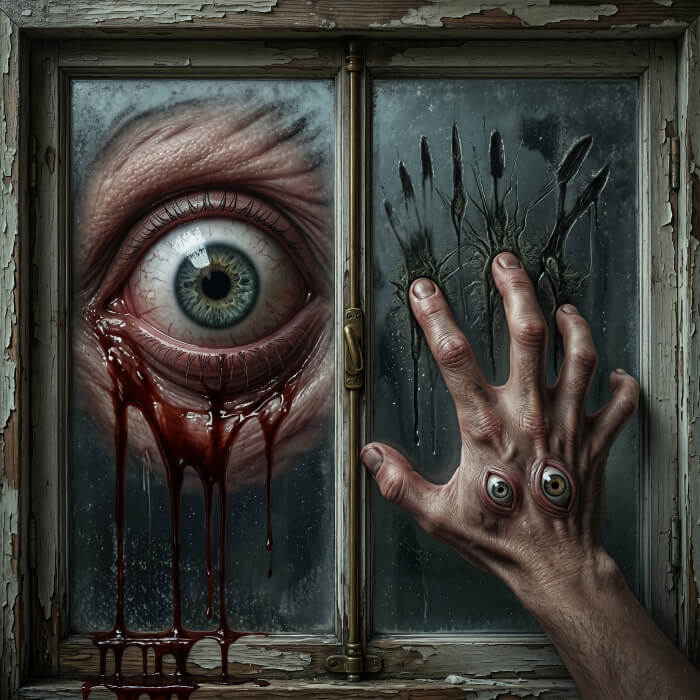
Instead, sunlight poured through tall rectangular openings—windows—surrounding the room on every side. Clean glass panes framed views of the forest beyond. Birds flitted between branches, and the sky glowed pale blue.
Oliver stared, confused.
He swung his legs off the bed and walked slowly to the nearest window.
The glass felt cold beneath his fingertips.
He leaned closer.
Outside, the forest stretched endlessly, quiet and still.
Something about it felt wrong.
He moved to another window.
Then another.
Each one showed the same thing: trees, underbrush, empty wilderness.
No trail.
No signs of civilization.
Just forest.
A chill crept up his spine.
He turned back toward the center of the room—and noticed something he had missed before.
Scratched into the wooden floor beneath the bed were faint markings.
Names.
Dozens of them.
Carved deeply into the wood, overlapping and crowding together.
Martin Cole
Evelyn Shaw
Robert Haines
Lucas Ward
Oliver’s breath quickened.
At the very bottom of the list, freshly carved, was a name he recognized instantly.
Oliver Bennett
His own handwriting.
The realization hit him like a punch to the chest.
He staggered backward, heart racing.
“No,” he whispered.
Memories flickered at the edges of his mind—fragments he couldn’t quite grasp. A sense of déjà vu so strong it made him dizzy. The smell of damp wood. The feeling of lying in that bed before.
He rushed to the door and grabbed the handle.
It wouldn’t budge.
He pulled harder.
Locked.
Panic surged.
He turned toward the windows, desperate for escape, and ran to the nearest one. But as he reached out, his reflection caught his eye.
He stopped.
The face staring back at him was smiling.
Not a normal smile.
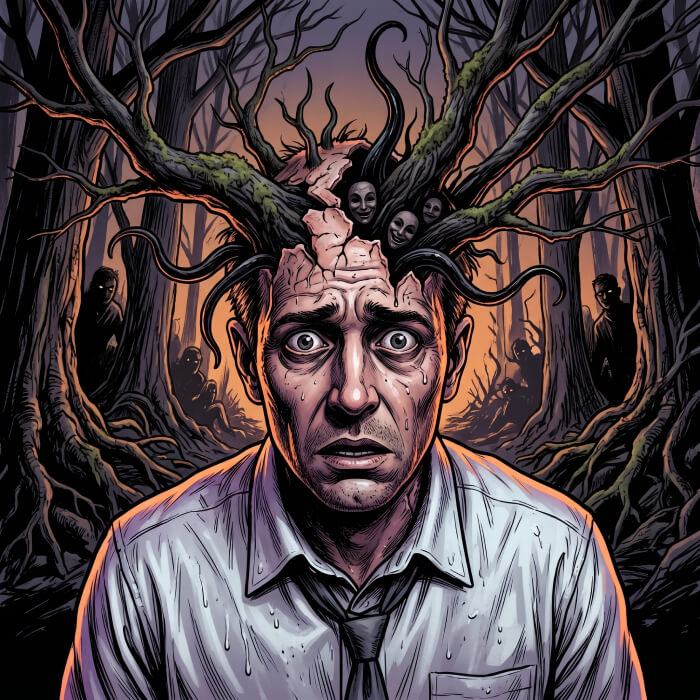
A wide, frozen grin stretched across his lips, pulling at the corners of his mouth in a way he couldn’t control. His eyes were open too wide, unblinking, filled with silent terror.
He tried to scream.
No sound came out.
Slowly, helplessly, his body turned toward the center of the room.
Toward the empty wall behind the bed.
The wood there began to ripple, like paint spreading across a canvas.
Color formed.
Shapes emerged.
Brushstrokes appeared where there had been nothing.
And within seconds, a new portrait materialized on the wall.
A man standing stiffly, smiling unnaturally.
Eyes wide with fear.
Trapped forever inside the frame.
Outside the cabin, the forest remained quiet.
Patient.
Waiting for the next lost hiker to wander off the trail. 🌲
Comments
0 approved comments
Be the first to comment
No one has said a word about this story yet. Set the tone.