
They didn’t read my sentence out loud.
That was the first thing I noticed. No proclamation, no dramatic pause, no crowd roaring behind a sheet of glass. In Virel, punishments were usually theater. Executions were events—tickets sold, betting pools opened, commentary streamed worldwide. People liked to feel righteous while watching someone else suffer.
But for me, there was no ceremony.
Just two guards, silent as stone, unlocking my cell at an hour that didn’t exist on any schedule. One of them avoided my eyes. The other stared straight through me like I was already gone.
“On your feet,” one said, eventually. His voice cracked slightly.
That should have warned me.
My name is Rowan Hale. I was a civil archivist once—nothing heroic. I catalogued public records, trade permits, census data. Boring, harmless work. Except I noticed patterns. Numbers disappearing. Names duplicated. Entire districts quietly erased from the registry.
I made the mistake of asking why.
They called it sedition. Treason by implication. A crime vague enough to justify anything.
They marched me through corridors I’d never seen before, far beneath the city. The walls changed from stone to smooth white panels, seamless and sterile. The air grew colder with every step, thinner somehow, like it had been filtered too many times.
We passed doors.
Some shook violently.
Some wept.
Some were silent in a way that made my skin crawl.
Finally, we stopped at a door that looked unfinished. No handle on the inside. No markings. Just white, like it hadn’t decided what it was yet.
One guard hesitated.
“Please,” I said, not even sure what I was asking for.
He swallowed and shoved me inside.
The door closed behind me with a sound like a held breath finally released.
The room was empty.
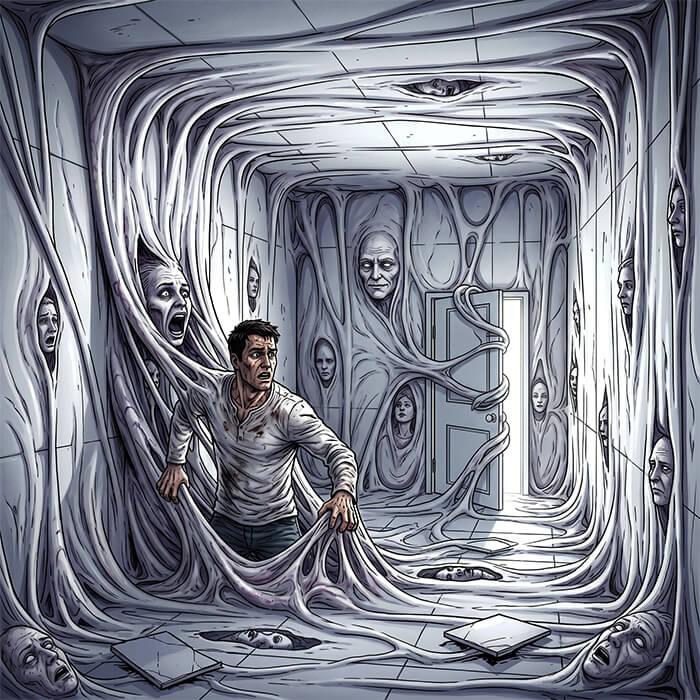
No chair. No drain. No camera that I could see. No seams. Just white—floor, walls, ceiling—all identical, all painfully bright without a visible light source.
I laughed once, sharp and hysterical.
“A box,” I muttered. “You’re putting me in a box.”
I paced the room. Twelve steps wall to wall. Maybe thirteen if I stretched. I pressed my ear to the surface—solid, cold, faintly humming. Like machinery buried deep underground.
Minutes passed.
Nothing happened.
I sat down, back against the wall, knees pulled in. If this was psychological torture, it was lazy. Sensory deprivation, maybe. Starve me of stimulation until I lost myself.
I could survive that.
Then I noticed something subtle.
The wall against my spine felt… closer.
I stood abruptly and crossed the room. Pressed my palm flat against the opposite wall. Counted steps back.
Eleven.
My heart stuttered.
“No,” I whispered.
I measured again.
Ten and a half.
The room wasn’t empty.
It was moving.
The motion was impossibly slow. Not enough to trigger panic at first. More like a suggestion. A creeping doubt. Something you could argue with yourself about.
I braced my hands against opposite walls and pushed.
The resistance was absolute. Like trying to shove the planet aside.
Hours passed. Or minutes. There were no cues—no hunger at first, no fatigue, no sense of time passing at all. Just the gradual realization that the space I occupied was shrinking, and there was nothing I could do to stop it.
I shouted.
My voice died inches from my mouth.
The walls swallowed sound. No echo. No feedback. Just silence pressing back.
Eventually, I couldn’t stretch my arms fully. Then I couldn’t stand upright. I crouched, then knelt, then curled instinctively as the ceiling descended like a judgment.
Panic arrived late—but when it came, it was complete.
I screamed until my throat tore. I pounded the walls until my knuckles split. I begged, reasoned, threatened.
Nothing.
The room did not hurry.
That was the worst part.
When the walls finally stopped, I was folded into myself like a broken thing. Knees crushed to chest. Chin forced down. Breathing shallow, every inhale scraping pain through my ribs.
I sobbed with relief.
It had stopped. This was the endgame, then. Leave me here to starve. To dehydrate. Slow, humiliating death.
I could endure that.
I closed my eyes.
And felt the floor pulse.
Just once.
Like a heartbeat.
I opened my eyes.
The white surface beneath me subtly flexed, almost like muscle tightening under skin.
“No,” I whispered again. “No, no, no.”
The walls responded—not with sound, but with pressure. A gentle, deliberate squeeze.
Understanding arrived like ice water down my spine.
This wasn’t a machine.
This wasn’t a room.
It was something else.
The whispers began softly.
Not words at first. Just breath. So close it felt like it came from inside my skull. I squeezed my eyes shut, convinced I was hallucinating.
Then it spoke my name.
Perfectly.
“Rowan.”
I thrashed, or tried to. The room tightened in response, not enough to injure—just enough to remind me who was in control.
“You noticed,” the voice said. “That’s why you’re here.”
Images flooded my mind without warning. Records I’d seen. Names I’d archived. People who vanished quietly, their data reassigned, their existence redistributed across spreadsheets and ledgers.
“They thought you’d stay blind,” the voice continued. “Most do.”
“Please,” I croaked. “I won’t tell anyone.”
The room pulsed again. Amused.
“Oh, you already did.”
I don’t know how long I stayed there. Days. Weeks. The room adjusted constantly—never enough to kill me, never enough to let me rest. Every time I drifted toward unconsciousness, it squeezed. Every time my breathing slowed, it nudged my ribs just enough to force a gasp.
I stopped screaming eventually.
That seemed to please it.
Sometimes it showed me things.
Other rooms. Other people. A woman suspended in darkness, limbs stretched impossibly long. A man buried upright in stone, mouth frozen open mid-sentence. A child’s room filled with toys that screamed when touched.
“This is justice,” the room said once. “This is balance.”
“People are watching, aren’t they?” I whispered.
“Yes.”
I laughed weakly. “Then why don’t they see this?”
A pause.
“They do.”
The door opened one final time.
A man stepped inside, immaculate in dark gray, face uncovered. He looked ordinary. Mid-forties. Calm eyes. Clean hands.
“Rowan Hale,” he said. “You’ve lasted longer than expected.”
“Kill me,” I whispered.
He smiled—not cruelly, but with genuine admiration.
“That’s not the purpose.”
He gestured, and the room loosened just enough for me to slump flat against the floor, gasping.
“You weren’t sentenced to die,” he continued. “You were sentenced to remain.”
“To remain?” I echoed.
“Infrastructure requires caretakers,” he said. “Witnesses. Anchors.”
Cold understanding dawned.
“You need someone inside it,” I said.
“Yes,” he replied. “And now, it knows you.”
He turned to leave.
“What happens when I die?” I asked desperately.
He paused at the threshold.
“You won’t,” he said.
The door closed.
The white walls expanded.
Not outward—inward.
Into me.
I felt myself stretching, thinning, spreading. My memories pulled apart, catalogued, indexed. My fear became texture. My thoughts became structure.
I screamed once.
Then I understood.
The room wasn’t killing prisoners.
It was building itself out of them.
And now, when new footsteps echo outside, when another door opens, when another soul is folded into the white—
I feel it.
I welcome them.
Because the room is hungry.
And I am everywhere.





Comments
0 approved comments
Be the first to comment
No one has said a word about this story yet. Set the tone.