
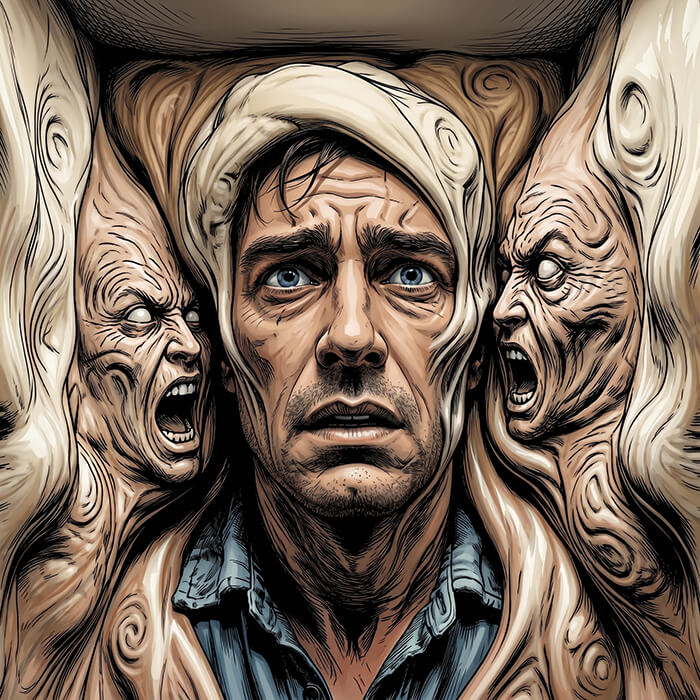
I knew the king didn’t forgive easily. In the Kingdom of Darswyn, defiance wasn’t just punished—it was broadcast. Every rebellion, every outburst, every crime against the crown ended in spectacle. And now it was my turn.
My name is Callum Hargrove, and I was the latest disgrace. I had argued with the wrong councilman, tried to expose the corruption in the city, and—naively—believed truth mattered. That foolishness had brought me here, to a cell I would never leave alive.
The guards came for me without ceremony, their boots clicking against the stone floor like a death knell. No words, no glances, only the icy weight of inevitability. They shoved me forward, down the endless hall, past doors behind which screams echoed—a grotesque symphony of human terror.
Finally, they stopped at a plain, white door. No markings, no number. It was innocuous, almost sterile. One guard grabbed me by the shoulder, shoved me in, and left without a word. I barely had time to brace myself before the door closed with a hiss.
The room was… empty.
Pure white. Ceiling, floor, walls—all a blank, unbroken void of antiseptic white. I sighed, foolishly, thinking this must be some kind of waiting room. Maybe they’d release me, or at least, it would be a short torment before the execution.
I was wrong.
At first, nothing happened. Minutes passed. Then, slowly, imperceptibly, the walls seemed to move—or maybe it was me. Maybe my mind was twisting the reality of the room. I leaned forward, pressing my palm against the wall, trying to measure.
It was moving.
Slowly, silently, the space I had been given was shrinking.
Panic rose, not in the hot rush of fear, but in the slow, creeping certainty that this was deliberate. The guards hadn’t wanted me dead by sword or poison—they wanted me to suffer. To understand the inevitability of my helplessness.
I pushed against the walls. Nothing. I shouted. The white space swallowed my voice. My legs braced, my arms extended, but the walls yielded only imperceptibly. My heart thudded violently, and sweat pooled in the hollows of my back. Every breath was shallow, as though the air itself was conspiring to smother me.
Hours—or was it days?—passed. Time lost all meaning. Hunger and thirst gnawed at me, but fear was far worse. Every nerve screamed as the walls crept closer. My knees pressed to my chest, my head forced downward. My spine bowed under pressure, and I discovered muscles I didn’t know existed, straining against the inevitability.
Then, just as I thought I could endure no longer, the motion ceased.
The room stopped shrinking.
I was trapped, barely able to move, the walls pressing on every inch of my body. My chest heaved. My throat burned. My thoughts turned inward, desperate, fragmented.
And then it happened.
A sound, faint but undeniable, from the ceiling. A soft click. A whisper of movement. My head snapped up, trying to locate it. My eyes, adjusting to the sterile white, caught a glimmer—a line, barely perceptible, tracing the ceiling. And then another.
The ceiling wasn’t just stationary—
it was breathing.
I could feel it now. The walls, the floor, the ceiling—they weren’t merely closing in. They were alive. Deliberately, cruelly alive. Every shift of the white surfaces pressed, pushed, teased my body. I felt their intention like teeth against my skin, mocking me.
Days—or hours?—merged. I lost count of how long I had been crouched like a cornered animal. My lips cracked, my fingernails dug into my palms, my mind teetering on the edge of sanity.
Then I noticed movement in the corners—shadows, impossible in this unbroken whiteness. But they were there, crawling along the edges of my vision. Faces? Shapes? I couldn’t tell. They moved faster whenever I tried to focus, darting just beyond comprehension.
I screamed. The sound ricocheted in the white void, swallowed by the walls themselves. There was no echo, no relief—only the pulse of white pressing against me.
And then the whispers began.
First faint, like someone speaking behind a thick door. Then louder. The voices—hundreds, maybe thousands—chanted, muttered, laughed. They were not outside the walls.
They were the walls.
They were everything.
“You will not leave,” they hissed.
“You cannot endure.”
“This is worse.”
I understood. My execution wasn’t to end me. It was to break me. The king’s audience didn’t want my death—they wanted my submission, my terror, my slow erosion. They wanted me to see how powerless a single human could be.
Days bled into nights that didn’t exist. Hunger and thirst were distant concerns compared to the omnipresent pressure of white, the living walls, the voices that knew my every fear, my every weakness.
Finally, my body, broken and trembling, slumped against one wall. My arms barely lifted, my legs cramped, my lungs raw from shallow breaths. I couldn’t move, couldn’t think clearly, couldn’t hope.
Then the door opened.
A figure, masked in black and gold, stepped inside. The guards had been nothing but messengers. This was the architect. The king’s executor, the designer of horrors.
“You survived,” he said calmly, almost pleasantly.
“I… I can’t…” I rasped, unable to even lift my head.
“You can’t,” he said. “And yet you do. That is what makes you… interesting.”
He pressed a button on a small console. The walls contracted slightly, nudging me onto my back. The ceiling lowered imperceptibly, pinning me like a slab.
And then, in a whisper that made me wish I were deaf:
“This room adapts. It learns. It remembers. It hates. And now… it likes you.”
I realized the truth in a heartbeat more terrifying than any execution I had imagined. This was no mere room. No mere punishment. It was alive. Patient. Eternal.
“You will never leave,” the executor said. “And I… well, I will leave. But the room? It stays.”
The door clicked shut.
The ceiling shifted slightly, nudging my head down. The walls flexed against my ribs. The floor pressed against my knees.
I screamed, but my voice was swallowed, absorbed.
This. This is worse.
And I knew, with a clarity so pure it burned in my mind, that I would be trapped forever. My death, my freedom, my hope—all irrelevant.
The room had claimed me.
And now it would never stop.



Comments
0 approved comments
Be the first to comment
No one has said a word about this story yet. Set the tone.