
The sleep clinic was on the second floor of a medical park off the state road, above a dentist and a travel agency that had gone under so long ago its posters had bleached white in the window. Curtis parked at 8:40 and sat in the truck for a while with the engine off.
He had his gym bag on the passenger seat with a toothbrush, sweatpants, and a T-shirt in it, which was what the packet had said to bring. He had the packet, too, folded into quarters, soft at the creases from being carried in his back pocket for eleven days.
He was forty-four years old and he drove a school bus, and eleven days ago he had stopped at the four-way on Ridge and Coulter and had not started again.
Thirty-one kids on the bus. A junior named Bryce had come up the aisle and shaken his shoulder, and Curtis had come back into himself with his hands still on the wheel and his foot still on the brake and no idea at all where the last minute had gone. Not tired. Not dizzy. Just gone, the way a room is gone when the light's off, and then the light's on and the room was there the whole time and you were the thing that wasn't.
The district put him on leave. The district said sleep study or no route in the fall.
He got out of the truck.
The waiting room had a fish tank with no fish in it, just water and a light and a plastic castle, and Curtis was still looking at it when the door buzzed and a woman came out with a clipboard.
"Curtis?"
"That's me."
"I'm Rhonda. I'm your tech tonight." She was maybe fifty-five, heavyset, in scrubs with cartoon owls on them, and she shook his hand like a person who'd shaken a lot of nervous hands. "You eat?"
"Little bit."
"Coffee?"
"Not since noon. It said not to."
"Good boy." She held the door. "Come on back."
The hall behind the door had six rooms on the left, numbered one through six, each with a heavy door and a small brass frame on it where a name card could go. Five of them were empty frames. Room 4 had a card in it that said CURTIS, in ballpoint, in handwriting that leaned hard to the right.
On the right side of the hall there was one more door with a square window in it, and through the window he could see monitors — a lot of them, more than seemed necessary, blue-lit and stacked in a rack.
"Busy night?" he said.
Rhonda didn't look up from the clipboard. "It's just you."
Room 4 was made to look like a hotel room and did not succeed. Queen bed, quilted spread, a nightstand, a lamp with a fake candle bulb, a print of a lighthouse. The wall behind the headboard had a plate on it the size of a dinner plate with dozens of little colored holes in it, like a switchboard. In the ceiling corner there was a black glass dome with a camera in it.
"That's infrared," Rhonda said, following his eyes. "I can see you all night, but it's not a picture like you're thinking. You look like a green ghost. Everybody looks awful. Don't take it personal."
She had him change, then sat him on the edge of the bed and started gluing.
It took forty minutes. She parted his hair with a wooden stick and rubbed each spot with grit and pressed a sensor down and taped it and moved on, and she talked the whole time, easy and low, about her son in Missoula and about how the building's AC ran cold in July no matter what anyone did. Sensors behind his ears. Two on his temples. Two under his chin. Six on his scalp. Sticky pads on his chest and one on each leg above the ankle. A belt around his ribs and another around his belly. A clip on his finger with a red light in it. A thin plastic cannula that hooked over his ears and sat two prongs under his nostrils.
By the end he was wearing about thirty wires and they all ran back into a gray box the size of a paperback that she clipped to the front of his shirt, and one thick braided cable ran from that box to the plate on the wall.
"Okay." She stood back and looked at him. "Rules. There's three."
"Okay."
"One. You don't take any of this off yourself. Not the belts, not the cannula, nothing. You gotta pee, you call me, I come unplug you, I plug you back in after. That's my whole job. Don't be shy about it, I've got a bladder like a thimble myself."
"Got it."
"Two." She tapped the black dome in the corner. "You talk out loud, I hear you. There's no button. You don't have to sit up or wave or nothing. Just say my name and I'm there. All right?"
"All right."
She stopped. Curtis was expecting three to be don't drink anything after eleven or don't watch TV.
"Three," Rhonda said. "Once the lights are out, don't sit up."
He waited for the rest of it.
"Because of the wires?" he said.
"Sure," she said. "Because of the wires."
She turned off the lamp on her way out and the room went to a dark that was total, and the door shut with the heavy hydraulic sigh of a door built to shut properly.
He didn't sleep.
Of course he didn't. Nobody sleeps in those places; he'd read that on a forum. You lie there with a red light on your finger and thirty wires in your hair and a camera watching you, and you think about how a person is supposed to fall asleep on command like it's a thing you do with your hands.
He lay on his back. He listened to the AC. He counted the little clicks the building made.
At 11:20 by the numbers on the wall clock, which had a face that glowed faintly green, the speaker in the ceiling came on with a soft pop.
"How we doing, hon."
"Not great."
"That's normal. Don't chase it." A pause, and the sound of a chair. "Try lying on your back for me."
Curtis looked at the ceiling.
He was on his back. He had been on his back since she'd closed the door, hadn't moved an inch, because the belts pinched when he turned.
"I am on my back," he said.
There was a silence on the intercom that went on too long to be nothing.
"Right," Rhonda said. "So you are."
Around midnight he heard snoring.
It came through the wall on his left, which was the wall shared with Room 5, and it was that wet ragged kind, a saw going through a soaked board, a snag and a catch and a long shuddering drag. Curtis lay and listened to it and felt better than he had all night, because it meant somebody else was in the building with him, some other poor guy taped up like a science project, and misery is company even through drywall.
It also meant Rhonda had lied to him. It's just you.
He knocked on the wall. Two soft knuckle raps, half a joke.
The snoring stopped.
Then, from the other side: two soft knuckle raps.
Curtis smiled in the dark. He knocked three times, quick, the way you do — shave and a haircut without the last part.
Three came back. Same rhythm. Same weight.
He knocked once.
One came back.
He held still and didn't knock at all, and after eleven or twelve seconds, a single knock came anyway. Then another. Then a slow steady patient tapping, and it was not coming from Room 5. It was coming from inside the wall, low down, near the floor, and it was moving. It went along the baseboard toward the corner behind the headboard, and it stopped there, right about where that plate was with all the little colored holes in it, right about where the thick braided cable went into the wall.
"Rhonda," Curtis said.
Nothing.
"Rhonda."
The speaker popped. "I'm here, hon."
"There's — something's in the wall. An animal or something. It's been knocking."
"Okay," she said.
"Okay?"
"I don't want you to sit up," Rhonda said. "That's all I want. Can you do that for me?"
He had his phone.
You weren't supposed to. The packet said leave electronics in the car. But he'd left it in his sweatpants pocket like everybody does, and now he pulled it out and the screen threw a rectangle of white light across the ceiling and he had never in his life been so happy to see a lock screen.
6% battery. He'd forgotten to charge it. Denise always said he'd die in a ditch someday with a dead phone.
He thought about texting her and didn't, because she'd been asleep since ten and because he could already hear how it would sound. Something's knocking in the wall. Forty-four years old.
Instead he did the thing that would ruin him.
He opened the camera. He flipped it to the back lens and turned on the night mode, because he wanted to see the corner behind the headboard, the plate, the baseboard, whatever was in there. He held the phone up over his chest and turned it slow, panning the room on the screen, and the screen showed the room in that grainy brightened way, the lighthouse print, the nightstand, the door, the ceiling dome.
Then it showed the bed.
There were two shapes under the quilt.
He was lying on the left. There was another long shape on the right, under the covers, turned away from him, the blanket rising and falling.
Curtis lowered the phone.
The right side of the bed, with his own eyes, in the dark, three feet away, was flat and empty and cold when he put his hand on it, and he put his hand on it, he made himself, and there was nothing there but a cold sheet.
He lifted the phone again.
The shape had rolled over. It was facing him now. He couldn't see a face, only the pale smear where a face goes, and it was close, closer than it had been, and the blanket was pulled up under its chin the exact way Curtis pulled his own blanket up under his chin, and it was very, very still, in the way of something that has decided to hold still.
The battery hit 3% and the phone shut off.
"RHONDA."
Pop. "I'm here."
"Somebody's in the room with me."
"I know."
Curtis's whole body had gone to water. "You know?"
"I've got the camera, hon. I see everything." Her voice was so calm. That was the worst of it, the flatness of it, a woman reading a temperature off a chart. "Now listen to me. You've done real good tonight. Better than most. But I need you flat and I need your eyes shut, and in about four hours the sun's gonna come up and I'm gonna come in and take all this off you and you're gonna go home."
"Come in now."
"I can't come in while you're awake."
"What?"
"I can't unhook you while you're awake," Rhonda said. "That's not how it works."
"That doesn't make any sense —"
"Curtis." And her voice changed. It wasn't unkind. It was the voice of somebody who's tired and has said a thing a great many times. "This is your eleventh study. Do you know that?"
He sat up.
The wires went taut all together, thirty little tugs across his scalp and chest and legs, and two of them tore off with a sting, and the belts bit.
He got the finger clip off. He got the cannula off his face. He unclipped the gray box from his shirt and let it swing on the braid, and he stood in the dark with the whole harness hanging off him like he'd walked out of a wrecked machine, and he stumbled toward where the door was.
The braided cable came with him. That was the thing. He'd assumed it was three or four feet of slack out of the wall plate and it wasn't. It played out behind him, and out, and out, and when he found the door and hauled it open, the cable ran out of the room with him into the hall.
The hall lights were on. All six doors were open.
Room 1: a kid in the bed, maybe twenty, wired to the eyes, arms at his sides. Skinny. Bad tattoo on the forearm, a Chinese character that Curtis had gotten in Kearney in 2001 and had spent every year since telling people meant strength.
Room 2: a man in his late twenties, heavier through the shoulders, wedding band new and shining.
Room 3: thirties. Beard he'd had for two years and shaved off when Denise said it made him look like his father.
Room 5: a man of fifty-something, gray coming in at the temples, deep lines from the nose down.
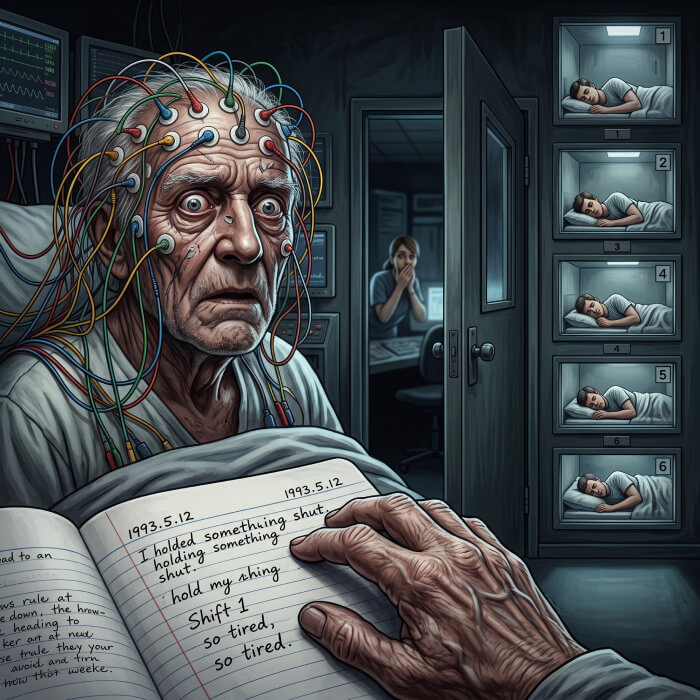
Room 6: old. Very old. Sunk into the bed like something set down and forgotten, mouth open, wires in what was left of the hair.
All of them breathing. All of them asleep. All of them him.
And every one of them had a braided cable running out of a plate in the wall behind the headboard, and all six cables ran along the baseboard of the hall, gathered and taped in a bundle as thick as his wrist, into the door on the right with the square window.
The control room was cold and smelled like burnt dust off electronics.
There was a desk that ran the length of the wall and a rack of monitors above it, black and white, one for each room. Room 1 through 6. In five of them a green ghost lay flat and still. The sixth, Room 4, showed a bed with the covers thrown back and nobody in it.
There was a chair, an office chair with the foam coming out of one arm, and the seat of it was warm. He put his hand on it. Warm like somebody had just gotten up.
There was a headset on the desk with the mic boom bent up.
And there was a binder.
It was thick, three rings, the plastic gone gummy at the corners, and it was open, and it was a log. Columns ruled by hand. Date. Room. Hours. Status.
The top page had last night's date on it, and the night before, and the night before that. He turned back. The dates ran backwards, one line per night, no gaps, not one, and he went back a hundred pages and the ink changed from ballpoint to felt tip and the paper went brittle and yellow, and he kept going, and the year on the page in his hands was 1993, and he had been eleven years old in 1993.
Every line in the STATUS column said the same thing.
Contained.
Every line but the last one, which was tonight, which was blank, because it hadn't been filled in yet.
And the handwriting in that binder, on every page, going back thirty-one years, leaned hard to the right.
It was his.
The speaker on the desk crackled.
He looked up at the monitor for Room 4, the empty one, and it wasn't empty anymore. Something was sitting on the edge of the bed. It was shaped like a man. It was shaped, exactly and precisely, like him, and it sat with its hands on its knees and its head turned up toward the corner of the ceiling, looking into the camera, looking through the camera, at him.
It didn't have wires on it. That was what he noticed. Not one.
The speaker crackled again and his own voice came out of it, warm and reasonable, the voice he used on the bus radio, the voice he used when Denise was upset and he was smoothing it over.
"Hey," it said. "Hey, buddy. Open the door."
Curtis didn't move.
"Come on," it said. "It's been thirty years. Aren't you tired?"
He was. God, he was.
"Nobody got hurt," it said. "Did they? Not one kid on that bus. I stopped, didn't I? I put my foot on the brake and I stopped, because you were still in there fighting me for the wheel, and that's all this is, Curtis. That's all it's ever been. One of us awake. One of us watching." A soft laugh. His laugh. "You just got tired. It happens. Sit down."
On the monitor, the thing on the bed stood up and walked out of frame, toward the door of Room 4.
Down the hall, footsteps.
Curtis reached out and turned the deadbolt on the control room door, and it turned smooth and easy and well-oiled, like a bolt that had been thrown and drawn a very great many times, and then he sat down in the warm chair with the foam coming out of the arm.
He picked up the pen. He filled in the last line of the log, in his own handwriting, and the word came out of him without any thinking at all, the way your hand knows a signature.
Contained.
He put on the headset and bent the mic down. The footsteps had stopped outside the door. He looked at the six monitors, at the five sleeping men and the one empty bed, and he keyed the mic for Room 4 and heard his voice go out into the hall through the ceiling speaker, and it did not sound like his voice anymore. It sounded like a woman in her fifties who had done this shift a long, long time.
"Okay, hon," Rhonda said. "Back to bed. Lights out."
A long pause in the dark hallway. Then, slow, the sound of somebody walking back down it.
"Three rules," she said. "You know 'em."
At 6:04 in the morning Denise got a text from her husband's phone, which was strange, because his phone had died at midnight and she'd know, she always knew, she'd been the one to buy him the charger he never used.
It said: Study went fine. They kept me a little longer. Go back to sleep.
She read it twice. Curtis never said a little longer. Curtis said a bit.
She put the phone face down on the nightstand and lay back and told herself she was being ridiculous, and the room was warm and the light was coming up gray behind the blinds, and she was most of the way under when the phone buzzed again, once, on the wood.
She reached over without opening her eyes and turned it over and looked at it through one eye.
Same number. Two words.
Don't wait.






Comments
0 approved comments
Be the first to comment
No one has said a word about this story yet. Set the tone.