
I met Elena on a Tuesday night, which already felt like a bad omen.
Tuesday nights are for leftovers and half-hearted gym visits, not romance. Still, I’d been swiping out of boredom, thumb sore from rejection disguised as “no match,” when her profile stopped me cold.
No filters. No duck lips. Just a woman leaning on a wooden railing, hair pulled back, eyes sharp and amused like she was in on a joke no one else had caught yet.
Bio:
Civil engineer. Collector. Don’t be boring.
Short. Efficient. Confident.
I liked that.
We matched within minutes.
She messaged first.
Elena: You look like someone who talks too much in public and listens too little in private.
Me: That’s… disturbingly accurate.
Elena: Good. Come over for dinner tomorrow. I don’t do coffee dates.
That should’ve been the first red flag.
Normal women insisted on public places. Safety. Boundaries. Elena didn’t hesitate.
But confidence is attractive. And I’d always believed hesitation was a weakness.
So I said yes.
Her apartment was in a converted warehouse near the rail yard—brick exterior, tall windows, exposed beams. Artsy, sure, but a little isolated. The kind of place people scream in without neighbors hearing.
I noticed that thought and laughed it off.
Get a grip.
She opened the door barefoot, wearing jeans and a loose sweater, hair pinned up with a pencil like she’d been working. The place smelled faintly of oil and cedar.
“Shoes off,” she said. Not rude. Firm.
I complied.
The living room was clean to the point of obsession. Everything had a place. No clutter. No personal chaos. It felt… curated.
“Drink?” she asked.
“Beer’s fine.”
She handed me one, then gestured down the hall.
“I’ll finish dinner in a minute. You can look around if you want. Just—don’t touch anything yet.”
That “yet” lingered.
I smiled, assuming she was joking.
I was wrong.
Her spare room stopped me in my tracks.
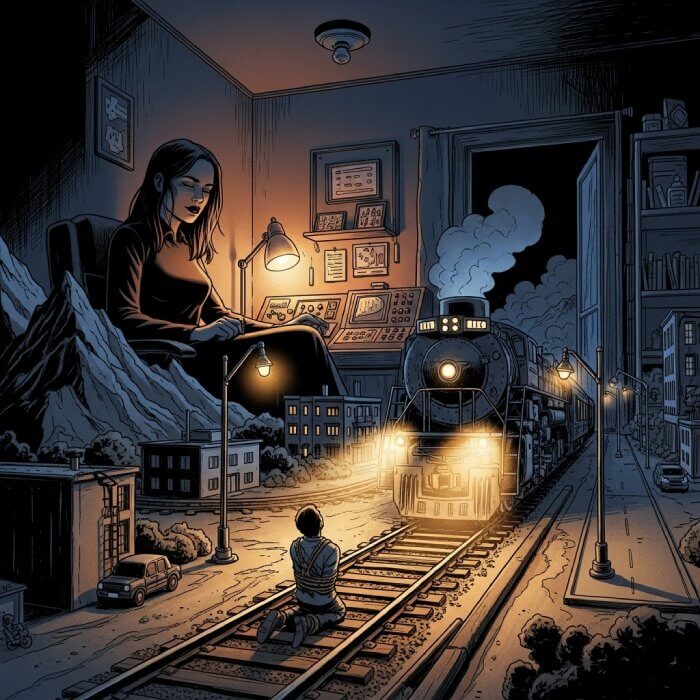
The entire space—floor to waist height—was consumed by a model railway.
Not a hobby set. Not something you’d buy at a mall.
This was a world.
Mountains rose from sculpted foam and painted stone. Rivers curved realistically, water catching the light like glass. Towns sat nestled between forests, every building weathered, every sign legible. I could read restaurant names through tiny windows. Streetlights glowed warm and dim.
It was breathtaking.
And unsettling.
Tiny people stood frozen mid-life. A man tying his shoe. A woman yelling into a phone. A kid dropping an ice cream cone.
They looked… specific.
Too specific.
“That’s new,” I muttered.
“Impressive, right?”
I turned. Elena leaned against the doorframe, arms crossed, watching my reaction like a scientist observing an experiment.
“Yeah,” I said slowly. “You build all this yourself?”
“Every millimeter.”
I crouched instinctively, peering closer. The details were insane. A gas station with branded cups. A bar with tiny neon signs. Even graffiti under a bridge.
“Must’ve taken years,” I said.
“It did.”
I reached out, intending to steady myself against the table’s edge—
“Don’t.”
Her voice cut sharp.
I froze.
“Sorry,” I said. “Didn’t mean—”
“Everything here is calibrated,” she said calmly. “One wrong pressure point can ruin weeks of work.”
I straightened, hands up. “Got it. My bad.”
She studied me for a long moment, then smiled again.
“Dinner’s ready.”
We ate pasta and talked. She was smart—too smart, maybe. Corrected my assumptions without embarrassment. Asked questions that made me aware of my own pauses.
When I joked about my “old-school values,” she raised an eyebrow.
“Define that,” she said.
“You know. Marriage. Family. Roles.”
“Ah,” she said lightly. “Control.”
I laughed. “Discipline.”
“Same word, different scale,” she replied.
I didn’t like that. But I didn’t push.
After dinner, she poured wine and suggested we go back to the train room.
“I want to show you something.”
I followed, buzzed and curious.
She flicked a switch.
The room came alive.
Lights blinked on across the miniature towns. Signals flashed red and green. And then—movement.
A locomotive rolled out from a tunnel, wheels clicking softly. Steam puffed convincingly from its stack.
I felt a grin spread across my face.
“Okay. That’s cool.”
“Watch closely.”
She adjusted a dial. The train slowed, then stopped beside a platform.
A tiny door slid open.
Inside the passenger car… people.
Not plastic molded figures.
People.
Tiny. Real. Breathing.
I stumbled back.
“What the hell is that?”
“Perspective,” she said. “You should get closer.”
I laughed, shaky.
“Nope. You got me. Really good animatronics.”
“They’re not.”
My stomach dropped.
She met my eyes.
“You talk about molding people. About shaping women into something useful. You ever wonder how small you make them feel?”
I shook my head, backing away.
“This isn’t funny.”
“It’s not meant to be.”
I turned for the door.
It didn’t open.
Something struck the back of my knee. I went down hard, breath knocked from me. The world tilted, shrank—
And then everything did.
When I woke up, the air felt thick. Heavy. My chest struggled to rise.
I tried to move. Couldn’t.
Ropes pinned me flat.
Panic surged as I realized the ground beneath me vibrated faintly.
Metal.
Tracks.
I screamed. The sound came out thin. High. Wrong.
My voice echoed off painted cliffs.
I was small.
Tiny.
No—scaled.
I lay on the tracks, bound, staring up at a sky that was clearly painted plywood.
“Elena!” I screamed.
Her face appeared above me, vast and godlike, eye filling the horizon.
“You’re awake,” she said. “Good. I was worried the dosage was off.”
“You’re insane!” I sobbed. “Let me go!”
She crouched, finger the size of a truck looming near my face.
“You broke my trees,” she said calmly. “You decided I needed fixing.”
“I was joking!”
“So was I,” she said. “At first.”
The ground trembled.
A distant whistle echoed through the mountains.
The train was coming.
She stood, walking toward the control panel.
“I keep this world balanced,” she said. “Every figure here earned their place. Abusers. Control freaks. Men who thought size meant superiority.”
She looked down at me one last time.
“In my world,” she said softly, “scale matters.”
The engine roared closer.
I screamed until my throat bled.
The last thing I saw was her hand adjusting a dial—precise, careful—before the train filled my vision and the world went dark.
Somewhere in a quiet apartment near the rail yard, a locomotive runs on time.
And if you lean close enough to the tracks, you might swear you can hear screaming.
But it’s very small.
And perfectly contained.






Comments
0 approved comments
Be the first to comment
No one has said a word about this story yet. Set the tone.