
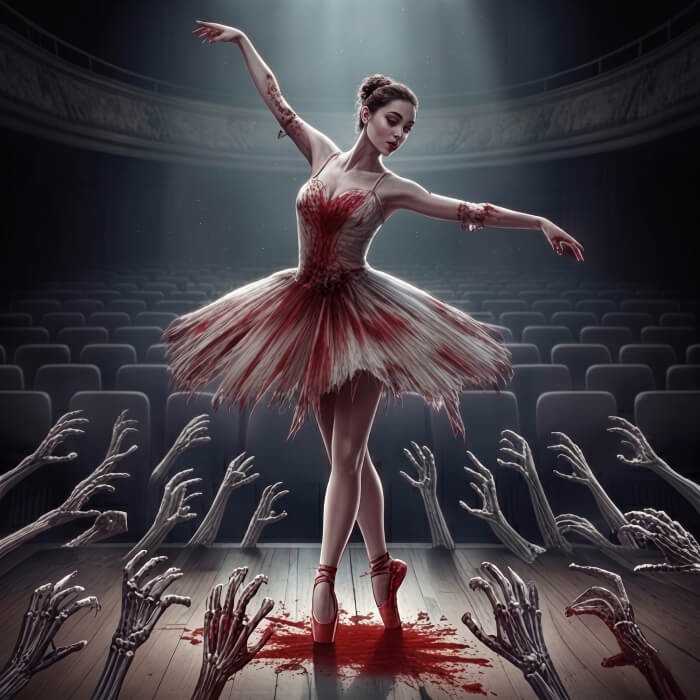
By the time I lifted the camera, the first dancer was already onstage.
That alone should have told me something was wrong.
We don’t bring performers out before the lights rise. It ruins the illusion, makes the audience restless. But there she was—center stage, weight balanced perfectly over her toes, chin lifted, arms curved as if holding a breath that would never end.
She didn’t blink.
The house lights dimmed. The murmuring softened. Someone behind me whispered that this company always started strong.
Two more dancers were guided into place from the wings. Not walked. Guided. Their slippers were aligned precisely on the tape marks, heels kissing the floor like they were being lowered onto glass.
A fourth joined them last.
They stood in a row, evenly spaced, bodies tuned like instruments waiting to be struck.
I brought the camera to my eye.
The music began with a sound that didn’t belong.
Not a wrong note—worse. A flat, metallic impact, sharp and echoing, like a tool dropped from height. It rang through the theater and vanished.
No one reacted.
The orchestra recovered immediately, strings smoothing over the gap like skin pulled tight over bone. The familiar melody followed, sweet and swelling.
Onstage, the dancers moved.
Their timing was flawless. Too flawless. Arms rose together, elbows angling a fraction too sharply, wrists rotating with mechanical certainty. Their faces wore the same expression: calm, distant, devotional.
I panned the camera slowly, searching for a tremor, a breath, anything human.
Nothing.
“Rig check,” I murmured into my headset. “Did something fall?”
A pause. Then: “All clear.”
The dancers continued.
Halfway through the first sequence, one of them landed badly from a jump.
Her foot struck the stage at the wrong angle. I heard it—an ugly, hollow sound, like wet wood cracking.
She did not cry out.
She corrected her balance a heartbeat late and folded back into formation. The others adjusted around her, spacing recalibrated like a system compensating for a fault.
I zoomed in.
Her ankle bent where it shouldn’t.
The audience sighed appreciatively.
Movement began above the stage.
I caught it in the corner of my vision—shadows shifting along the scaffolding, shapes hunched low to avoid the lights. The catwalk wasn’t supposed to be occupied during performances.
“Who’s up there?” I asked.
Static crackled. Then: “Maintenance.”
That was a lie. Maintenance doesn’t sweat like that.
The music swelled. I raised the volume, letting it swallow the faint sounds of scrambling feet and hurried whispers.
The dancers’ heads tilted in unison.
Not toward the audience.
Upward.
At the climax, everything unraveled.
The orchestra cut out mid-phrase. No resolution. Just silence.
The dancers froze.
For a moment, the theater held its breath.
Then—slowly, deliberately—they turned toward the curtain. Their movements were stiff now, joints catching like rusted hinges. One by one, they were pulled backward, disappearing into the velvet darkness as the curtain dropped.
Applause erupted.
People stood. Cheered. Whistled.
They thought it was art.
The lights came up.
I lowered the camera.
“Stage manager to wings,” someone said. “Now.”
Behind the curtain, the air was thick and sour.
The dancers hung where they’d been left, suspended from nearly invisible lines. Their arms were still raised, fingers curled in perfect arcs. Sweat—or something like it—ran down their temples.
Their eyes were open.
Above us, the operators clung to the rigging, knuckles white, faces gray with exertion. One of them laughed shakily.
“That was close,” he said. “One more bad landing and she’d have torn clean through.”
I nodded.
My hands were steady. They always were.
We’d reinforced the harnesses after the last incident. Added more anchor points. Distributed the weight better.
Still—bodies are heavy.
Even when they stop fighting.
We cut them down carefully.
The one with the broken ankle made a soft sound when she was lowered onto the mat. Not a voice. Just air escaping.
“Sedation held?” I asked.
“Mostly,” someone replied. “We’ll need a stronger dose next time.”
I looked at the dancers. At the bruises blooming beneath their makeup. At the places where wires had bitten into flesh.
“They held beautifully,” I said.
And they had.
Later, alone in the control room, I reviewed the footage.
Frame by frame.
There it was—the moment the music faltered. The instant when the dancers’ smiles wavered, just barely, like a signal trying to break through.
I paused the video.
Zoomed in.
For a fraction of a second, one of them looked straight into the camera.
Her eyes were wet.
Aware.
I deleted the frame.
The company was already planning the next production.
More dancers. New choreography. Improved systems. The audience would come in droves—tickets were nearly sold out.
People love precision. They love discipline. They love beauty that doesn’t talk back.
As I shut down the monitors, I caught my reflection in the darkened screen.
Still.
Upright.
Perfectly aligned.
Tomorrow, I would climb the scaffolding myself. Show them how to distribute the strain. How to hold the pose longer.
After all—
Just because the dancers were dead didn’t mean the performance was finished.
And the audience deserved an encore.



Comments
0 approved comments
Be the first to comment
No one has said a word about this story yet. Set the tone.