
Daniel first noticed it while hugging his daughter.
Lucy came at him full speed the way kids do, careless and certain he would catch her. He bent, wrapped his arms around her small body—and something inside his chest pulled inward, sudden and sharp, like a muscle seizing where no muscle should be.
He sucked in air through his teeth.
“Dad?” she asked, already pulling back.
“I’m okay,” he said, forcing a smile. “Just moved wrong.”
It lingered after she ran off. A tightness under his ribs. Not pain exactly—more like resistance. As if his chest hadn’t appreciated being opened that wide.
That night, lying in bed, Daniel became aware of how much effort breathing took. Each inhale felt slightly constrained, like his lungs were pushing against something that didn’t want to give.
He rolled onto his side and slept badly.
Over the following weeks, small things began to feel wrong.
Stretching hurt. Yawning hurt. Laughing too deeply sent a thin blade of discomfort through the center of his chest. He found himself hunching without thinking, shoulders drawn forward, posture collapsing in on itself.
Oddly, it helped.
At work, he caught his reflection in the elevator doors and frowned. His frame looked tighter somehow. More compact. Not thinner—contained.
He pressed a hand to his sternum and felt a faint tenderness, deeper than muscle. Beneath it, something felt… closer than it should have been.
The doctor told him not to worry.
“Could be inflammation. Stress. Postural strain,” she said, tapping at his chart. “Your scans look unusual, but not dangerous.”
“Unusual how?” Daniel asked.
She hesitated. “Your ribs appear slightly repositioned.”
“Repositioned by what?”
She smiled in that practiced way doctors use when they don’t want to finish a thought. “Bones shift over time.”
That night, Daniel heard the first sound.
A low, internal creak.
Not loud. Not sharp. Just a slow, deliberate noise, like something tightening by degrees. He lay frozen in bed, listening, heart racing as the sound repeated—deep inside him.
When he moved, it stopped.
In the morning, he found a bruise blooming beneath his skin, dark and deep, exactly where the pressure had been strongest.
Daniel stopped hugging people.
Not because he was afraid—at least not consciously—but because contact made the sensation worse. Any pressure against his torso caused an immediate internal response: a tightening, a drawing inward, like a reflex.
Lucy noticed.
“You don’t hug me anymore,” she said one evening, not accusing. Just sad.
“I do,” he said too quickly. “I just—my chest hurts sometimes.”
She wrapped her arms around him anyway, gentle but firm.
Something inside him shifted.
A deep, grinding adjustment, followed by relief so intense it made his knees wobble.
Daniel held her tighter than he meant to.
The changes accelerated after that.
His ribs no longer felt like separate bones. They felt connected. Coordinated. When he breathed, there was a faint delay, as though his body was deciding whether the expansion was allowed.
At night, the creaking returned—longer now, louder. He could feel the motion beneath his skin: ribs sliding fractionally inward, overlapping space that used to belong to lungs, heart, liver.
The pressure was constant.
And yet… familiar.
Daniel began sleeping curled forward, arms wrapped around his chest. Lying flat felt wrong now, almost painful. Folding inward felt correct.
Protected.
The next scan alarmed them.
“Your thoracic cavity is reduced,” the specialist said, frowning at the images. “Your ribs are rotating inward. That shouldn’t happen.”
“What’s causing it?” Daniel asked.
No one answered.
They talked about rare conditions, unknown mechanisms, monitoring. No one used the word reversible.
At home, Daniel studied anatomy diagrams late into the night. The ribcage wasn’t just armor.
It was a structure designed to hold.
To contain fragile things. To keep them safe.
He thought about the years after his wife died. How he’d learned not to reach outward. How he’d folded himself small to survive the emptiness.
Maybe his body remembered.
Maybe it had decided the world was too wide.
The fracture happened quietly.
Daniel reached up to change a lightbulb, stretching without thinking. There was a dull internal snap, followed by breath-stealing pain.
The X-ray showed a cracked rib.
From compression.
The bone hadn’t broken outward.
It had been crushed from within.
That night, as Daniel sat alone in the dark, the pressure increased. Slowly. Steadily. His ribs pressed inward, not violently, but deliberately—like hands guiding him into a final posture.
Breathing became shallow.
Panic rose… then faded.
As the space inside him diminished, the pain softened. His body seemed to reward stillness. Surrender.
Daniel stopped resisting.
He ate little. Spoke less. Curled into himself whenever he could. The smaller he made himself, the better it felt.
Lucy watched him with quiet concern.
“You’re getting smaller,” she said once.
He smiled faintly. “Just tired.”
One night, she hugged him again—arms tight, face pressed against his chest.
Something inside him locked.
Daniel exhaled, long and slow, and held her.
For the first time in months, everything felt aligned.
The final night came without drama.
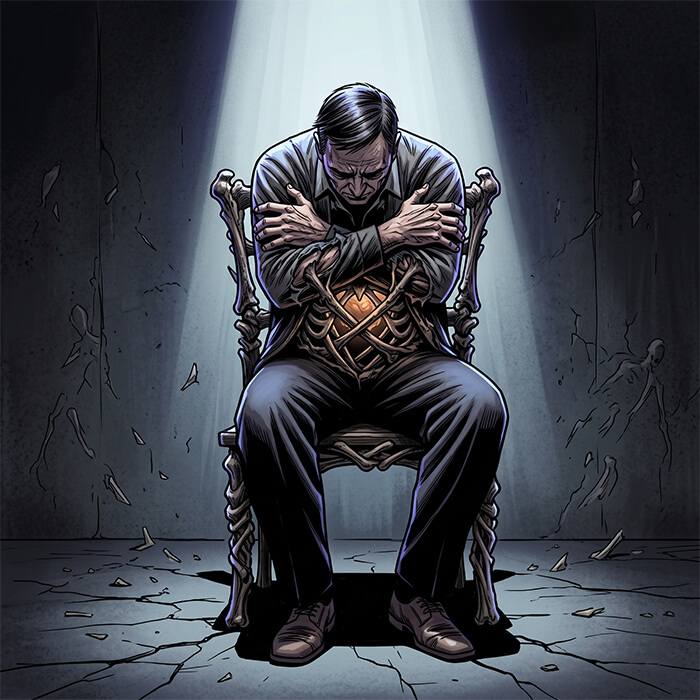
Daniel sat in his chair, folded forward, arms wrapped around his torso. The pressure inside him reached its peak—not crushing, but complete.
His ribs finished their work.
Overlapping. Interlacing. Sealing him inward.
There was barely room to breathe.
He didn’t try.
His last sensation was warmth. Containment. The profound relief of no longer having to hold himself together.
They found him the next morning.
Seated peacefully.
Curled forward.
Holding himself.
The autopsy noted extreme skeletal deformation, organs displaced beyond survivable limits. Cause of death: mechanical asphyxiation.
No one commented on how calm he looked.
Or how difficult it was to pry his ribcage apart.
As if it resisted being opened.
As if it knew its purpose had finally been fulfilled.







Comments
0 approved comments
Be the first to comment
No one has said a word about this story yet. Set the tone.