
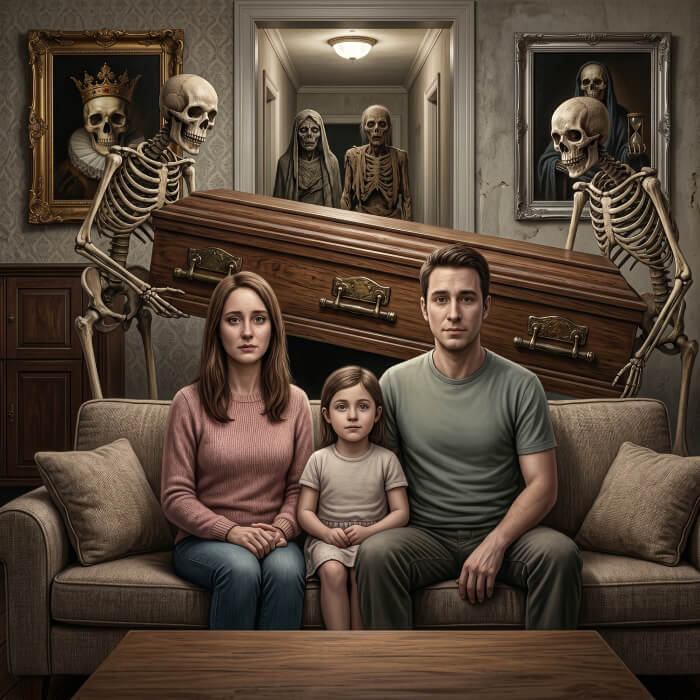
I met Sarah in a church basement that smelled like dust and instant coffee.
There was a paper sign taped to the door that said Loss Support – Thursdays, handwritten in blue marker. No logo. No sponsor. Just a circle of metal chairs and people who didn’t look at one another unless they had to.
My dad had died the year before. Heart attack in the shower. I found him. Sarah had lost both her parents in a house fire. That’s what she said, anyway. We didn’t compare notes beyond that. You didn’t need details to recognize the look.
We sat next to each other for weeks without speaking. Then one night she handed me a tissue before I realized I was crying. That was enough.
Grief makes shortcuts between people. Six months later we were living together. A year after that, I asked her to marry me. She cried when I proposed, but it was the quiet kind. I thought it was happiness.
Looking back, I think it was fear.
She waited until December to tell me.
We were driving north on the highway, snow piling up along the shoulders, the radio low and crackling. I mentioned stopping by her hometown on the way back, just to see it. I thought it might help.
She didn’t answer right away.
“We’re already going there,” she said finally.
I glanced at her. “I thought there was nothing left there.”
“There wasn’t,” she replied. Then, carefully, “There is now.”
I laughed, thinking she was joking. She didn’t join me.
“What does that mean?” I asked.
Her hands tightened on her coat in her lap. “My parents are alive.”
I slowed the car without meaning to. “Sarah. That’s not funny.”
“I know.”
The road hummed beneath the tires.
“They died,” I said. “You told me they died.”
“They did,” she said. “They still did.”
That should have been my cue to turn around.
Her family home wasn’t the burned-out shell she’d described. It was massive, clean, newly built. White stone, black gates, security lights glowing softly in the snow.
I parked and stared at it.
“Explain,” I said.
“They came back,” she said. “About two months ago.”
“Came back from where?”
She looked at me. Really looked at me. “From being dead.”
I opened my mouth. Closed it.
“I didn’t want to tell you until I was sure,” she continued. “I didn’t think it would work.”
“What would work?”
She unbuckled and opened the door. “Please don’t make a scene.”
The door opened before I could say anything else.
A man stepped out, smiling.
He looked like Sarah. Same mouth. Same chin. But his skin had an odd, waxy pallor, and his eyes didn’t track right when they moved.
“There you are,” he said warmly. “And this must be him.”
I shook his hand. It was cold. Not winter-cold. Refrigerator-cold.
“You’re… her father?” I asked.
He laughed. “Still getting used to saying yes.”
Inside, everything was immaculate. Expensive without being showy. Holiday decorations everywhere, perfectly placed.
A woman stood near the fireplace, adjusting an ornament. She turned when we entered.
“Dinner’s almost ready,” she said.
Her smile was too wide.
They acted normal.
That was the worst part.
They asked about my job. Complimented the ring. Told stories about Sarah as a kid—things I’d never heard, things too specific to be made up. They ate, though not much. They drank water, carefully, like it still surprised them.
I kept waiting for something obvious. Rot. Tremors. Anything.
After dinner, her father asked me to join him in his office.
“You have questions,” he said, pouring whiskey.
“I do,” I replied.
“Fair,” he said. “I would too.”
He explained it like a business pitch. Medical breakthroughs. Experimental recovery techniques. Reversal of cellular decay. He never used the word resurrection.
“Death is inefficient,” he said. “We’re fixing that.”
“And the cost?” I asked.
He smiled. “That depends.”
He slid his phone across the desk.
On the screen was a man sitting upright in a hospital bed, hair thinner, face older—but unmistakable.
My dad.
Alive.
My heart tried to crawl out of my chest.
“We located him through Sarah,” the man said calmly. “She spoke highly of you.”
I couldn’t speak.
“He’s stable,” he continued. “But incomplete. The process takes commitment.”
“What do you want?” I managed.
He leaned forward. “I want my daughter protected from uncertainty.”
The word landed heavy.
“You walk away,” he said. “We finish restoring your parents. Both of them.”
“And if I don’t?”
He didn’t answer right away.
“Then loss becomes permanent again.”
I didn’t sleep that night.
Sarah lay beside me, breathing evenly. When I finally spoke, she didn’t pretend to be asleep.
“They showed me my dad,” I said.
“I know,” she replied.
“You knew?”
She nodded. “They showed me my parents too. Before they brought them back.”
I sat up. “You didn’t tell me.”
“I wanted you to choose on your own,” she said softly.
“Choose what?”
She turned toward me. “Us. Or them.”
My stomach twisted. “That’s not a choice. That’s blackmail.”
She didn’t argue.
“You could have your parents back,” she said. “Forever. No more funerals. No more support groups.”
Something about the way she said it made my skin crawl.
“And you?” I asked. “What happens to you?”
She smiled. “I already chose.”
The room downstairs was full the next evening.
People I recognized. People from the group. Empty chairs suddenly accounted for.
They stood quietly, watching me.
Sarah’s parents stood at the front.
“We don’t force anyone,” her mother said. “We offer stability.”
“Everyone dies,” her father added. “We simply make sure it doesn’t stick.”
I looked at Sarah.
Her eyes were bright. Excited.
That’s when I understood.
This wasn’t about her parents.
It was about never being alone again.
The procedure hurt.
They lied about that.
Dying always does.
When I woke, everything felt clearer. Simpler. The noise was gone.
Sarah held my hand.
“See?” she said. “We don’t have to lose anyone anymore.”
I nodded.
Later, when they handed me a clipboard with new names for the support group, I didn’t hesitate.
Grief makes people honest.
And honesty makes them easy.
After all—
Nothing brings people closer together than loss.
Especially when you promise to take it away.





Comments
0 approved comments
Be the first to comment
No one has said a word about this story yet. Set the tone.