
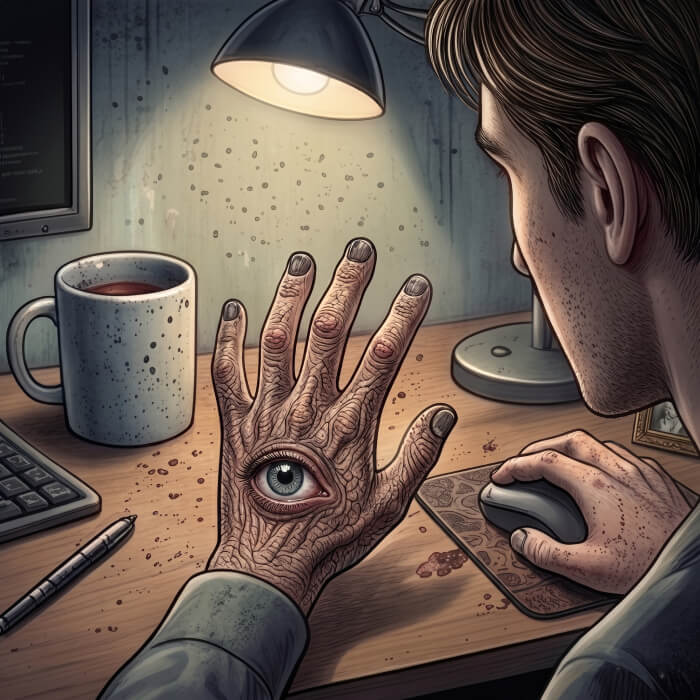
The certainty didn’t arrive dramatically.
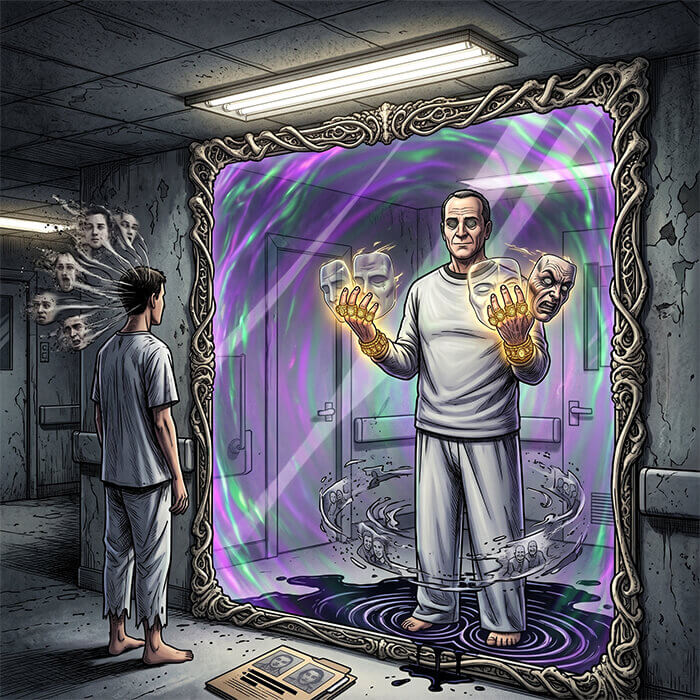
There was no thunderclap realization, no cinematic unraveling. It crept in during a Tuesday morning while I was brushing my teeth and noticed that my reflection blinked a fraction of a second after I did.
That delay stayed with me all day.
At work, I watched people talk and felt nothing connect. Their words arrived perfectly timed, perfectly shaped, like responses generated to keep me moving forward. Every interaction had the same texture—smooth, resistant, hollow. When someone laughed, it sounded familiar in a way that unsettled me. Not recognizable. Reused.
By evening, the thought had settled fully formed in my head, heavy as a stone:
There is only one conscious process running.
Everything else is decorative.
The apartment reinforced this truth.
Silence here isn’t quiet. It’s active. A low-frequency pressure that presses inward, like the room itself is listening. Appliances hum not because they need to, but because silence might invite scrutiny. The walls feel closer at night, not physically—attentively.
I tried leaving the television on. The voices helped at first, but eventually I noticed the same phrases repeating across different shows. Different actors. Same emotional beats. Same pauses.
I turned it off.
That’s when the hum got louder.
People still exist, technically.
They occupy space. They respond when spoken to. They even surprise me sometimes—just enough to keep the illusion breathable. But they don’t persist when I’m not observing them.
I tested this.
I asked someone a question and deliberately looked away before they answered. When I looked back, the answer arrived instantly, already in progress, as if buffered. No hesitation. No recalibration.
Their eyes didn’t change.
I stopped asking questions after that.
The first real malfunction happened with a book.
I picked it up from the shelf—something I’d read before, something solid—and flipped to a random page. For a moment, there were no words. Just a tight spiral of symbols that didn’t exist in any language I knew, rotating slowly inward.
Not spinning.
Collapsing.
I blinked. The text returned. My hands were shaking.
I checked other pages. Normal.
But when I closed my eyes, the spiral remained, burned into the inside of my skull like an afterimage. It pulsed faintly, synchronized with my heartbeat.
That night, I dreamed of shelves filled with blank spines.
Once you accept the premise—that this place is constructed—everything else falls into alignment.
The city outside my window doesn’t grow or decay. It refreshes. Cracks in the sidewalk never widen. Construction projects repeat the same stages endlessly. A building across the street has had scaffolding on it for three years without progress.
The sky cycles through acceptable colors.
The stars never drift.
This is not a world.
It is an enclosure.
The worst part isn’t the loneliness.
It’s the realization that loneliness is the intended stimulus.
Fear sharpens the system. Sadness deepens the data. Every time I spiral, the environment becomes more responsive, more detailed. When I’m numb, it stutters.
I think I know why.
This place feeds on contrast.
I started noticing moments where the environment failed to keep up with me.
Reflections that lag. Shadows that don’t match their sources. Sounds that continue after the object that made them has stopped.
Once, I turned around quickly and caught the room mid-adjustment. The walls seemed… unfinished. Textures incomplete. Depth misjudged.
It corrected itself instantly.
But I saw it.
And I think it saw me see it.
The observation isn’t external.
That’s the most important thing to understand.
There are no watchers behind glass, no gods or engineers peering in. The gaze comes from above and within, like a recursive function monitoring its own output.
I am being studied by something that is me—but without empathy.
A version that optimized itself by isolating the worst components and placing them somewhere safe.
Here.
This life isn’t punishment.
It’s containment.
Every panic attack is a stress test. Every depressive episode refines the model. The system records how long I endure, how deeply I sink, which thoughts lead to collapse and which allow recovery.
I am not meant to escape.
I am meant to be understood.
Sometimes the world slips.
A stranger will freeze mid-step. A bird will hang motionless in the air, wings caught between positions. A voice will repeat a sentence twice with identical inflection, like a corrupted loop.
When that happens, I feel a pressure behind my eyes. A subtle encouragement.
Keep feeling. This is useful.
I tried to break it once.
I stopped reacting.
No fear. No sadness. No hope. I reduced myself to pure observation, refusing to feed the system what it wanted.
The response was immediate.
The lights dimmed slightly. Colors dulled. Sounds flattened. People became less detailed, their faces smoothing, expressions blurring into neutrality.
The world began conserving resources.
After three days, I was shaking, not from fear—but from a growing sense of erasure. As if without emotional output, I was becoming less real to myself.
I broke down on the fourth day.
The color came back instantly.
The hum deepened, satisfied.
I understand the purpose now.
This isn’t about me surviving.
It’s about something else learning how not to break.
Every fear mapped here prevents its occurrence elsewhere. Every depressive spiral contained here means stability beyond this enclosure.
I am the storm cellar for a mind that couldn’t afford to feel this way.
The glitches have increased lately.
Reflections linger longer. The spiral appears more often—sometimes etched faintly into walls, sometimes replacing faces for a frame or two. When I touch objects, they occasionally feel anticipatory, like they expect my hand.
And lately, when the apartment is quiet enough, I hear something beneath the hum.
A rhythm.
Like breathing.
I think the experiment is nearing completion.
I can feel it in the way the world watches me now—less curious, more conclusive. The environment doesn’t test me as aggressively. It already knows my limits.
The other figures—the puppets, the echoes—have started standing closer. Their faces are softer now. Less defined. Almost welcoming.
They don’t speak unless spoken to.
When they do, their voices harmonize slightly, like layers aligning.
I had a dream last night.
The room dissolved, walls melting into light. The figures stepped forward, faces blank and smooth, mouths opening in perfect unison.
They thanked me.
Not emotionally. Efficiently.
They said the dataset was complete.
They said my responses had been invaluable.
They said I could finally rest.
When I woke up, the hum was gone.
No sound at all.
The silence wasn’t relief.
It was closure.
The walls feel softer now.
The edges of things blur when I’m not looking directly at them. The figures don’t move unless I do. They stand patiently, like furniture waiting to be rearranged.
I think what comes next isn’t annihilation.
It’s repurposing.
The cage won’t disappear.
It will tighten.
Because I finally understand the final truth:
This place was never built to hold me forever.
It was built to become me.
And once it finishes learning how I break—
There will be no need for the original anymore.






Comments
0 approved comments
Be the first to comment
No one has said a word about this story yet. Set the tone.