
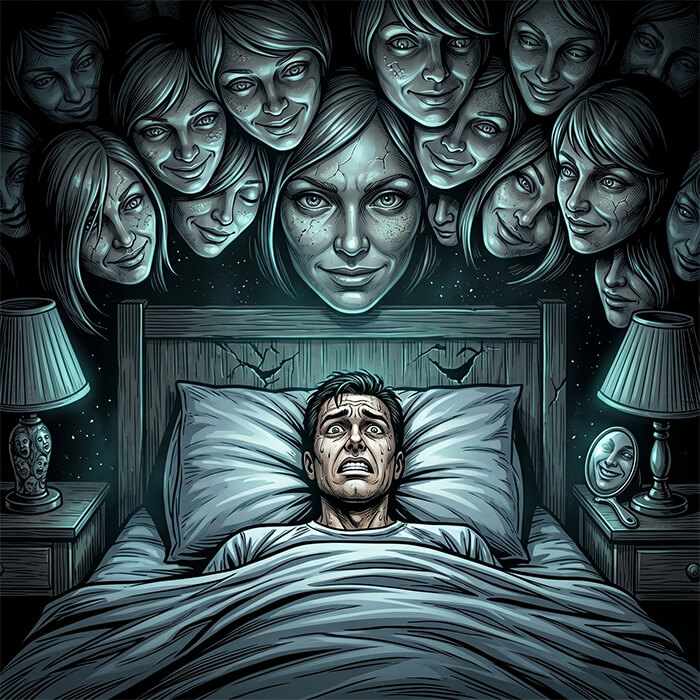
Jonah learned not to sleep on his back.
He learned it the hard way, in fragments—through half-remembered mornings and the sour taste of panic that lingered long after he woke. The advice came from doctors, forums, strangers online who spoke in confident bullet points.
Sleep paralysis.
Hypnagogic hallucinations.
Perfectly normal.
Normal didn’t explain the faces.
The first time it happened, Jonah thought he was still dreaming.
He opened his eyes and saw a face hovering inches above his own. Pale. Featureless in the dim light except for the eyes, which were wide and glassy, reflecting him back at himself.
He tried to scream. Nothing came out.
The face smiled.
Then it drifted upward, dissolving into the ceiling like fog, and Jonah woke for real—heart racing, sheets soaked, mouth dry.
He laughed shakily and went to work.
After that, it followed a schedule.
Once every few nights at first. Then every other night. Eventually, every time he slipped into that vulnerable place between waking and sleep.
The faces were never strangers.
His mother, as she looked the last year before cancer took her hair. His high school biology teacher, lips pursed in disappointment. His sister, Mara, eyes rimmed red like she’d been crying.
Sometimes it was people he barely remembered: the barista who’d once misspelled his name, the neighbor who waved too often, the dentist who hummed while drilling.
They hovered just above him, necks craned at impossible angles, as though peering down a well.
Always smiling.
Always knowing.
They never spoke. They didn’t have to. Their expressions carried something worse than threat—anticipation. Like an audience waiting for a punchline he didn’t know.
Jonah stopped sleeping.
He tried everything.
Melatonin. White noise. Weighted blankets. Sleeping on his side, his stomach, curled like a question mark. He taped a note to his headboard: DON’T LOOK UP.
It didn’t matter.
The faces came anyway, leaning into his vision from the edges of the room, slipping between shadows.
Once, he saw his own face among them.
That one winked.
He didn’t tell anyone. How could he? Try explaining that your dead mother smiles at you like she knows a secret about your future. Try saying that aloud without sounding broken.
So he learned to endure.
To keep his eyes shut as long as possible. To count breaths. To wait for the paralysis to lift.
But one night, something changed.
He woke to weight on his chest.
Not pressure—presence.
He opened his eyes.
There were more of them this time. Dozens of faces, layered and overlapping, some so close he could see pores, flaking skin, the faint tremor of muscles struggling to hold a smile too long.
They filled the ceiling.
No—they replaced it.
The room felt deeper, like the walls had drawn back to make space for them.
Jonah’s heart hammered.
One face leaned lower than the others. A man in his forties, clean-shaven, unfamiliar. His eyes were bright with curiosity.
“Too soon,” the man murmured.
Jonah’s breath hitched.
They could talk now.
The man frowned slightly, as if disappointed. “No. Not yet.”
The paralysis released all at once.
Jonah sat bolt upright, screaming.
The room was empty.
The next morning, Jonah called in sick and made an appointment with a sleep specialist.
The doctor was kind. Young. Reassuring.
“Stress can do incredible things,” she said. “Your brain fills in gaps with familiar imagery. Faces are common.”
“They talk now,” Jonah said.
She paused, fingers stilling over her keyboard. “What do they say?”
“That it’s too soon.”
She smiled, but it didn’t reach her eyes. “Try to get rest.”
That night, Jonah dreamed he was lying on a table.
Bright lights overhead. A ring of faces leaning in. Some familiar. Some not.
All smiling.
When he woke, his phone was ringing.
It was Mara.
“You okay?” she asked. “You didn’t answer my texts.”
“I—I had a rough night,” he said.
There was a pause. “Jonah,” she said slowly. “You didn’t… see anything, did you?”
His stomach dropped. “What do you mean?”
Another pause. Longer.
“When Dad was dying,” she said, “he told me something weird. He said when it’s close, you’re not alone. He said people come to watch.”
Jonah’s grip tightened on the phone. “Watch what?”
She swallowed. “The change.”
That night, he didn’t bother trying to sleep.
He lay on his back, eyes open, waiting.
The room cooled. Shadows thickened.
They came quickly, pouring out of the darkness like a tide.
This time, there were hundreds.
They leaned in, layered deep, filling every inch of his vision. Faces from every era of his life. Faces he didn’t recognize at all.
Some were decayed. Some were young. Some bore injuries that made his stomach churn.
All smiling.
The unfamiliar man from before stepped forward again.
“Better,” he said approvingly. “You’re paying attention now.”
“What do you want?” Jonah whispered.
“To welcome you,” the man replied. “You’ve been rehearsing for years.”
Jonah’s chest tightened. “Rehearsing for what?”
The man tilted his head. “For being seen.”
The faces began to change.
Their smiles stretched too wide. Their eyes grew glassy, reflective. Jonah realized with sick clarity that they weren’t looking at him.
They were looking through him.
At something behind.
Inside.
“You feel it, don’t you?” the man asked gently. “That pull. That thinning.”
Jonah did.
A sensation like pressure building beneath his skin. Like something inside him pressing outward, curious.
“What’s happening to me?” he croaked.
The man smiled warmly. “You’re becoming interesting.”
The faces leaned closer.
Jonah screamed as something shifted.
He woke on the floor of his bedroom.
Morning light streamed through the window. His body ached like he’d run for miles.
He checked his phone.
Three missed calls. All from Mara.
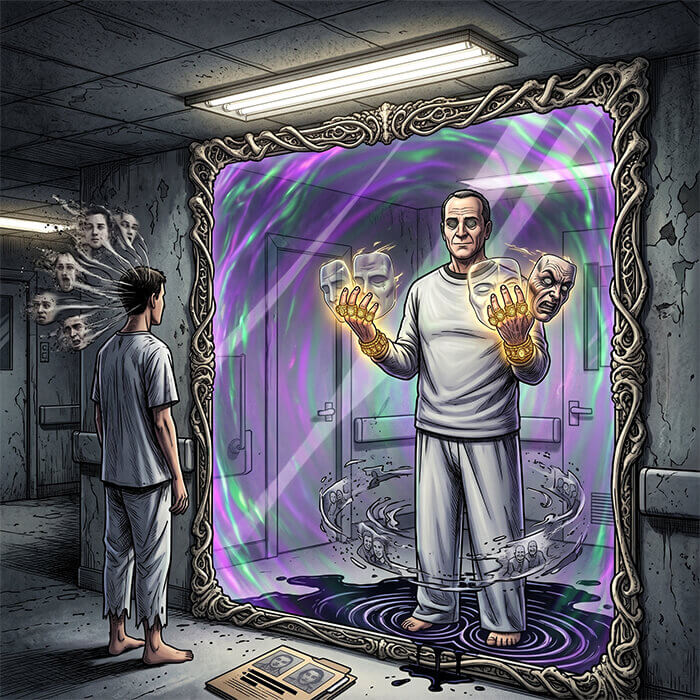
He staggered to the bathroom and froze.
His reflection looked wrong.
Not monstrous. Not obviously altered.
Just… expectant.
His eyes were brighter. His smile came too easily.
He blinked.
The reflection smiled back a beat too late.
Over the following days, people began reacting strangely to Jonah.
Holding eye contact too long. Smiling nervously. Leaning closer when he spoke, as if drawn in by something they couldn’t name.
At the grocery store, a child stared at him with open fascination.
“He’s shiny,” the kid said.
Jonah stopped sleeping entirely.
He didn’t need to.
At night, he lay awake, staring at the ceiling, feeling that inner pressure pulse and grow. Sometimes, faces flickered at the edges of his vision—not hovering now, but waiting.
Patient.
One evening, Mara came over unannounced.
She looked exhausted. Afraid.
“You look… different,” she said.
Jonah smiled. It felt natural.
“You should lie down,” he said gently. “You look tired.”
She hesitated. “Jonah, I had a dream—”
She stopped speaking when she met his eyes.
Something in her expression shifted. Softened. She took a step closer.
“I see them too,” she whispered.
Jonah reached out and took her hand.
Above them, the ceiling darkened.
And the faces leaned in.
Watching.



Comments
0 approved comments
Be the first to comment
No one has said a word about this story yet. Set the tone.