
I learned early how to be silent.
Silence wasn’t just encouraged in our house—it was survival. Floorboards memorized my weight. Doors knew my touch. Even my breathing learned to soften itself, like it was ashamed to exist.
Right now, silence is the only thing keeping me alive.
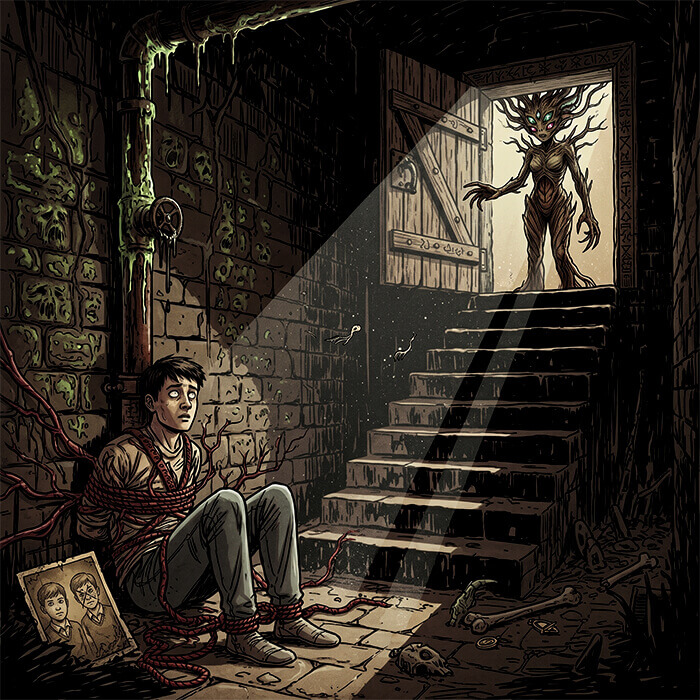
I’m in the cellar, wrists bound to a pipe that runs along the stone wall. The rope smells like soil and rust. Something wet drips nearby, slow and patient, like the house itself is counting down for me.
Above me—two floors up—my sister is asleep.
At least, I think she is.
I can hear her sometimes. Not footsteps. Not words. Just the soft, broken sound of crying that leaks through vents and walls where it shouldn’t fit. I don’t know how sound travels in this place anymore. I don’t know what’s real.
I just know I’m not allowed to cry.
If I do, he’ll come back down.
And next time, he won’t stop.
They told me I wasn’t their son anymore.
That happened three nights ago, but time stretches strangely in the dark. It could’ve been years. It could’ve been yesterday.
My father stood at the top of the cellar stairs, face carved into something stern and ancient. My mother stayed behind him, fingers wrapped so tightly around a length of chain that her knuckles had gone white.
They didn’t look afraid.
They looked relieved.
“It’s always one of them,” my father said. “Every generation.”
I remember blinking at him, waiting for the punchline. Waiting for the moment where he’d sigh and rub his eyes and say he was overtired. Or drunk. Or cruel in a normal way.
Instead, he kept going.
“When twins are born, one carries it. Wears the wrong skin. Waits.”
My mother nodded like she’d been waiting her whole life to agree with something.
They didn’t ask questions. They didn’t test theories. They didn’t wonder if they might be wrong.
They chose.
They chose me.
The first night was the worst.
They said words they didn’t understand, pulled from a notebook older than the house. My mother burned herbs that made my eyes sting and my lungs spasm. My father held me down while chanting, his voice shaking—not with doubt, but excitement.
Pain doesn’t make sense after a while. It becomes abstract. Like weather.
I begged them to stop. I begged for my sister.
That was a mistake.
My father’s face changed when I said her name. Hardened. Sharpened.
“She’s pure,” he said. “Don’t you dare drag her into this.”
After that, they gagged me.
That’s when the crying started.
Mine—or hers. I’m still not sure.
I think about the day we were born sometimes. Not the memory—just the story. How my mother said we didn’t cry at first. How the nurse joked we were “listening.”
We grew up inseparable. Shared a room. Shared secrets. Shared the blame when something went wrong.
But when we were older, something shifted.
She became the loud one. The angry one. The one who broke things and screamed and slammed doors.
I became quiet.
My parents said it was obvious what that meant.
The cellar door creaks.
I freeze, teeth pressed into the cloth between them.
Boots on wood.
Slow. Heavy.
I close my eyes and prepare myself for dying quietly.
But the footsteps hesitate.
Someone whispers my name.
It’s wrong. Too soft. Too unsure.
Not him.
The door opens just enough for light to spill down the stairs.
A figure stands there, silhouetted, breathing too fast.
“Hey,” she whispers. “Don’t make a sound. Please.”
My sister.
She rushes down the steps, hands shaking as she reaches for the rope. She smells like iron and smoke.
“You’re hurt,” she says. “I’m so sorry. I didn’t know—”
I try to tell her it’s not her fault. That none of this is real. That curses don’t work like this.
But my mouth only produces a broken sound.
She flinches.
Then she smiles.
Not her smile.
“I knew it,” she whispers. “I knew it was you.”
Her face… flickers. Just for a moment.
Like a reflection in warped glass.
The rope falls away.
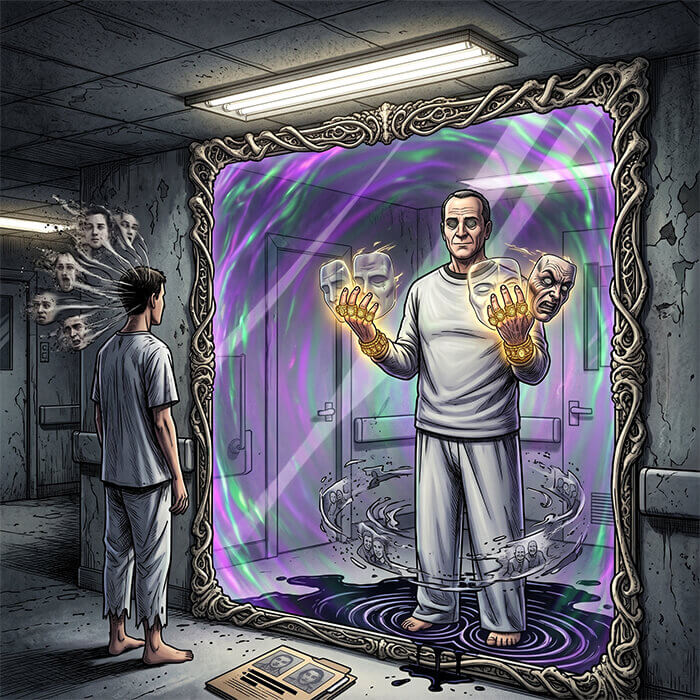
I don’t understand until she pulls me into her arms—until I feel the shape of my father’s shoulders around me, the familiar weight, the impossible warmth.
“I tried to be good,” she says into my hair. “I really did.”
Upstairs, something collapses. A scream cuts short.
She holds me tighter.
“They chose wrong,” she says. “But that’s okay.”
I feel her change against me—bones shifting, skin rearranging, something ancient stretching awake.
“They always do.”
And for the first time in my life, my father holds me like he means it.
I don’t cry.
I never needed to.
I was never the quiet one.
I was just the one who listened.


Comments
0 approved comments
Be the first to comment
No one has said a word about this story yet. Set the tone.