
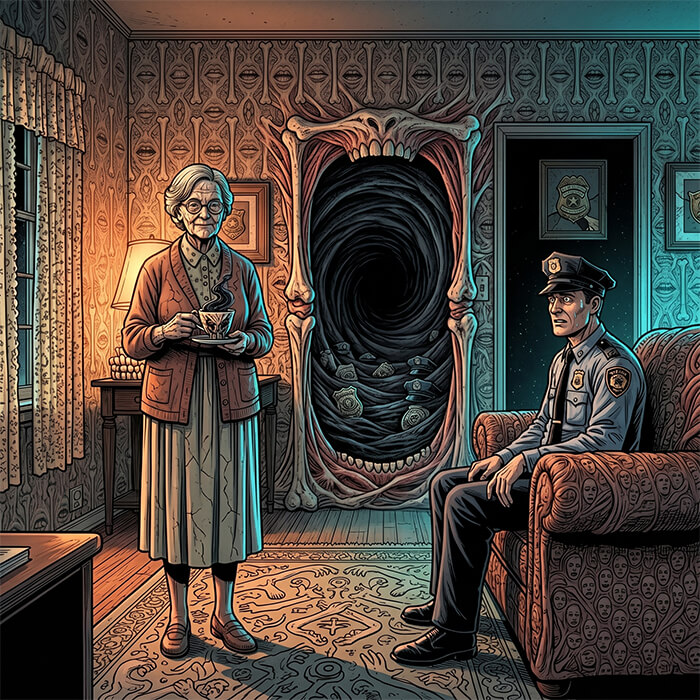
I have always believed that fear begins with discourtesy.
People expect monsters to snarl, to rush, to bare teeth. They don’t prepare for kindness done slowly, correctly, with both hands. They don’t know what to do with a woman who insists on manners.
That is why I made tea.
The officer—his name was Harlan, I remember that much—stood in my doorway pretending not to notice how long it took me to walk there. Young men are taught patience as a virtue, but only in theory. In practice, they shift their weight, scan the walls, note exits.
I waved him inside before he could offer to help.
“Shoes are fine,” I said. “The floors remember worse.”
He blinked at that, then smiled politely. He had the sort of face that trusted procedure. Clipboards. Checklists. He smelled faintly of cold air and plastic seats.
“I won’t take much of your time,” he said. “Just a few questions.”
“They always say that,” I replied, and shuffled toward the kitchen.
I heard him hesitate, then follow.
I hadn’t planned on tea until I saw his eyes drift to the cabinet.
That’s how you know what someone needs. You don’t ask. You watch what they reach for without touching.
“I didn’t know how you took it,” I said, arranging the tray. “So I brought options.”
He protested, of course. They always do. But when I carried the tray out, my hands shaking just enough to make him stand and take it from me, I knew I’d done it right.
People want to feel useful.
“I appreciate it, ma’am,” he said, setting everything down. “You didn’t have to.”
“Oh, I did,” I told him. “It’s been lonely since my sister passed.”
That was true enough. Loneliness is a flexible word.
He asked about the neighborhood. I answered carefully, generously. I spoke about stray cats and power outages and how children don’t knock anymore.
He drank while I talked.
Not much at first. Just enough.
“What kind of work do you do?” I asked.
“Missing persons,” he said, and paused. “Lately.”
“Hard on the soul,” I said.
He nodded. Took another sip.
The tea was mild. That was important. People expect bitterness when they expect harm. I learned long ago that sweetness disarms suspicion. It also carries things better.
When he finished the cup, I felt it—a soft shift in the room, like a curtain being pulled without sound.
His posture loosened.
“Would you like more?” I asked.
“No, thank you,” he said quickly, then frowned. “Actually… that was very good.”
I smiled.
The first thing the tea does is remove friction.
Not thoughts—people still think. Not morals—they still believe they’re good. It simply makes resistance feel unnecessary. Like standing against a breeze that smells pleasant.
“Do you enjoy helping people?” I asked.
He thought about it too long.
“Yes,” he said finally. “I think so.”
I poured another cup without asking.
He didn’t stop me.
By the time his second cup cooled, he had stopped checking his watch.
His gaze drifted, unfocused, like he was listening to something behind my words.
I set my cup down.
“Officer Harlan,” I said gently, “do you know why children disappear?”
He smiled faintly. “Because bad people exist.”
“That’s what you’re taught,” I agreed. “But it’s not the whole truth.”
I stood. My knees protested. Good. Pain keeps you honest.
“They disappear,” I said, “because no one teaches them how to stay.”
I led him to the basement door.
He followed.
That is the most dangerous moment—when someone still thinks they’re choosing.
The stairs creaked. The light hummed. The room smelled like chalk and damp paper.
He saw the door at the far end.
He saw the locks.
He did not scream.
“That’s not right,” he said mildly.
“No,” I agreed. “It’s necessary.”
He turned to look at me then, really look. His pupils were wide. His expression soft, attentive.
“What do you need me to do?” he asked.
I exhaled.
Relief is a terrible thing. It makes monsters out of ordinary people.
The children were quiet. They always are at that stage. Quiet doesn’t mean asleep. It means waiting.
I won’t describe them. That’s not the point.
“What happens now?” Harlan asked, hand resting near his radio, not activating it.
I handed him the keys.
“You’re going to make sure they stop looking,” I said. “You’re going to file the reports the way they should be filed. And if anyone comes asking questions—”
“I’ll handle it,” he said.
He sounded proud.
He stayed another hour.
We talked about his mother. About my sister. About how tiring it is to do the right thing when no one appreciates it.
Before he left, he paused at the door.
“You’re very kind,” he said.
I smiled.
They found him three days later.
Heart failure, they said. Stress. Long hours. No sign of foul play.
I attended the funeral.
I brought food.
The tea set remains clean.
I don’t use it often.
Only when someone knocks who thinks they’re here to help.
Because fear doesn’t begin with monsters.
It begins when someone sits down, accepts a cup,
and realizes too late
that they have already agreed.








Comments
0 approved comments
Be the first to comment
No one has said a word about this story yet. Set the tone.